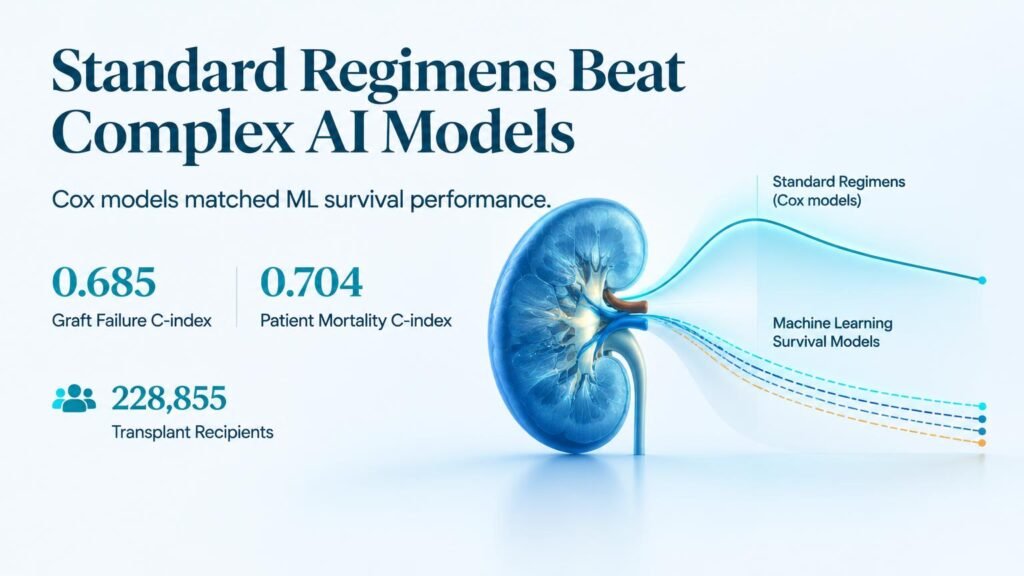
Complex machine learning models offer little advantage over classic statistics when predicting long-term kidney transplant survival.
Health systems routinely assume newer algorithms outperform established clinical statistics. A massive study tracking 228,855 deceased-donor kidney transplant recipients between 2000 and 2024 challenges that assumption. Standard statistical models predicted graft survival just as accurately as complex machine learning, while confirming which drug combinations keep patients alive.
That result changes how clinical teams should approach post-transplant analytics. Predictive complexity does not automatically yield clinical value.
Drug Regimens and Risk
The national study compared traditional Cox proportional hazards models against four machine learning frameworks: random survival forest, support vector machine, CoxNet, and XGBoost-Cox. Maintenance regimens pairing calcineurin inhibitors (CNI) with mycophenolate mofetil (MMF) delivered the strongest protective associations. The CNI + MMF combination reduced the hazard of graft failure by 28% (HR 0.72, 95% CI 0.70–0.74) and all-cause patient mortality by 22% (HR 0.78, 95% CI 0.76–0.81).
Adding steroids to CNI and MMF maintained protective benefits, though slightly attenuated. That triple therapy yielded a hazard ratio of 0.84 (95% CI 0.82–0.87) for graft failure and 0.90 (95% CI 0.88–0.93) for patient mortality. Recipient diabetes, dialysis dependence, older age, and higher Kidney Donor Profile Index scores remained powerful adverse predictors across all models.
Induction therapies showed sharp performance splits. Antithymocyte globulin (ATG) reduced risks, while interleukin-2 receptor (IL-2R) antagonists and Alemtuzumab had neutral effects. Strikingly, combining ATG and IL-2R therapies was associated with a 9% increased hazard of graft failure (HR 1.09).
Algorithms Versus Classical Statistics
- Traditional Cox regression achieved a graft failure discrimination C-index of 0.685.
- Patient mortality prediction reached a C-index of 0.704 under standard Cox regression.
- Machine learning models performed comparably to traditional regression without delivering a decisive leap in predictive accuracy.
The statistical takeaway is clear. Classical Cox models remain fully competitive for clinical inference, offering direct interpretability that high-dimensional algorithms struggle to match. Advanced predictive analytics should supplement standard tools rather than replace them, much like specialized diagnostics like Artificial Intelligence-Enabled Electrocardiography in Kidney Transplantation target niche physiological risks alongside core clinical frameworks.
Real-World Limitations
Retrospective registry data cannot eliminate unmeasured clinical confounding. These hazard ratios reflect observational associations rather than randomized trial proof, so drug selection may reflect unrecorded patient health differences.
For transplant centers, the practical strategy is clear. Stick with proven CNI and MMF maintenance regimens, use classical statistical models for routine patient communication, and reserve complex machine learning tools strictly for individualized secondary risk screening.
Read the full study in PLoS ONE.