
Consumer wearables are shifting from passive wellness tracking toward quantified clinical screening.
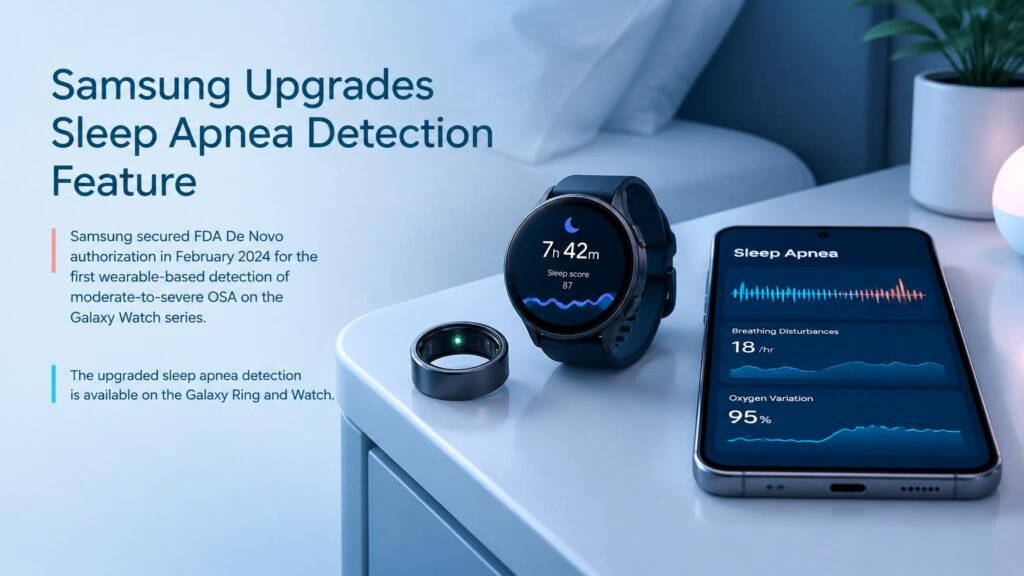
Most consumer health wearables offer vague warnings when physiological metrics drift outside normal ranges. Samsung has upgraded its sleep apnea detection feature on the Galaxy Ring and Galaxy Watch to move past simple binary alerts.
Quantifying Sleep Disruption
The updated algorithm quantifies hourly breathing disruptions across two nights of sleep monitoring. Recently cleared by the U.S. FDA and South Korea’s Ministry of Food and Drug Safety, it represents the first FDA-cleared sleep apnea metric on a smart ring.
Instead of merely flagging potential risk, the system provides a specific disruption metric for moderate-to-severe obstructive sleep apnea in adults aged 18 and older. This gives clinicians a concrete baseline when patients present with sleep complaints.
Clinical Utility and Limits
Over-the-counter screening tools reduce the barrier to identifying undiagnosed sleep disorders. Millions of adults live with sleep apnea without a formal diagnosis, largely due to the cost and inconvenience of traditional sleep lab studies.
However, consumer ring sensors do not replace clinical polysomnography. Wearable optical and movement sensors can misinterpret motion artifacts or minor respiratory fluctuations. A positive screening still requires diagnostic laboratory confirmation before initiating treatment.
This clearance establishes a clear wedge against hardware rivals that monitor sleep disturbances without regulatory clearance for specific clinical metrics. As consumer expectations shift, hardware makers must validate algorithmic accuracy to secure clinical credibility.