 Yusuf Yesil, MD, MIS
Mild neonatal hypoxic-ischemic encephalopathy (HIE) accounts for 30% to 50% of neonatal encephalopathy cases. Yet clinicians still struggle to predict which of these infants will develop long-term impairments based on standard bedside evaluations alone. Without reliable early signals, clinicians risk either subjecting healthy infants to unnecessary interventions or missing a critical window for early therapy in high-risk infants.
That ambiguity may finally disappear.
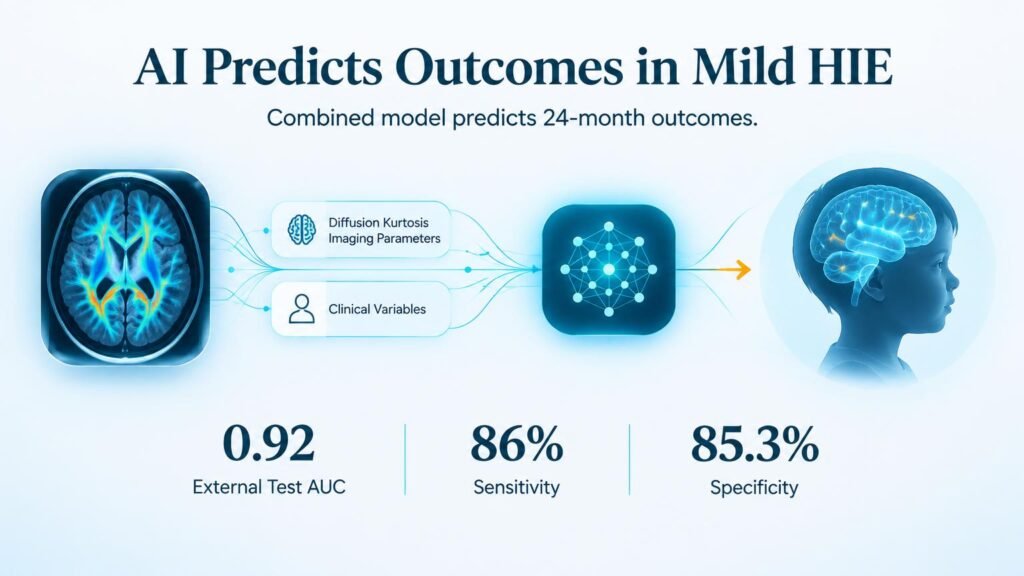
A prospective four-hospital study published in Radiology demonstrates that combining diffusion kurtosis imaging (DKI) parameters with clinical data allows machine learning models to forecast 24-month neurodevelopmental outcomes with remarkable precision. This work directly aligns with broader efforts in advancing neuroprognostication in neonatal encephalopathy.
Predictive Accuracy in the External Cohort
The study consecutively enrolled 740 neonates (mean gestational age 38.3 weeks ± 1.3; 404 female [54.6%]) between November 2019 and November 2023, tracking their progress through November 2025. The development cohort included 510 participants, while an external validation test set evaluated 230 participants. Researchers defined adverse outcomes as any Bayley Scales of Infant and Toddler Development (3rd edition) score below 85, cerebral palsy, or active epilepsy requiring treatment.
The researchers trained models using 49 DKI parameters and seven clinical variables. Key findings from the external test set include:
- Adverse outcomes occurred in 35.7% (182 of 510) of the development cohort and 34.8% (80 of 230) of the external test cohort.
- The combined clinical-imaging model achieved an AUC of 0.92, significantly outperforming both the clinical-only model (AUC 0.85, adjusted p = .004) and the imaging-only model (AUC 0.86, adjusted p = .005).
- At the operational level, the combined model demonstrated 86% sensitivity (69 of 80) and 85.3% specificity (128 of 150).
- Risk stratification yielded a 100% negative predictive value (61 of 61) for low-risk infants and an 88% positive predictive value (38 of 43) for high-risk infants.
Clinical Implications and Real-World Limits
The high negative predictive value offers immediate operational clarity. Clinicians can confidently avoid invasive monitoring or unnecessary therapies for infants classified as low risk. Conversely, an 88% positive predictive value gives care teams strong justification to enroll high-risk infants into early intervention programs immediately.
However, high diagnostic accuracy in a research trial does not automatically mean better patient outcomes. DKI acquisition requires specialized software and expertise that may not be available in smaller community hospitals. Furthermore, while the external test set spanned multiple centers, prospective trials must still prove whether acting on these predictions improves 2-year cognitive and motor function.
Read the full prospective study in Radiology.