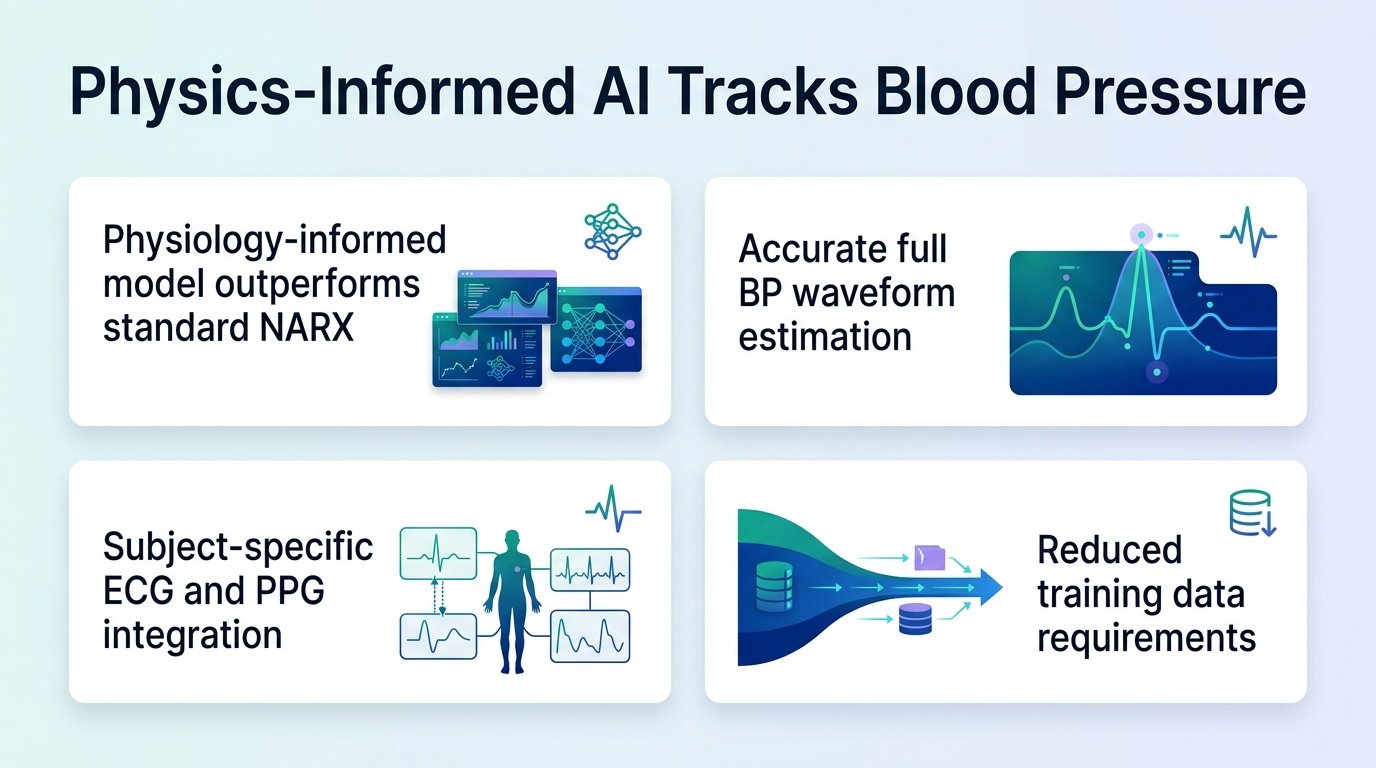
By blending cardiovascular physics into machine learning, researchers have cut the data needed to track continuous blood pressure in half.
Can we trust a neural network to monitor a beating heart when it does not understand basic physics? Purely data-driven models are notoriously fragile, often hallucinating blood pressure readings because they only spot correlation, not causation. This study introduces a physiology-informed model that forces the AI to respect the laws of human biology.
This shifts the focus from raw data volume to biological accuracy.
The implication is clear. We do not need massive, unmanageable datasets to train reliable medical AI if we build physical guardrails directly into the math. This challenges the “more data is always better” dogma in digital health. It builds on previous efforts to merge biophysical dynamics with data-driven methods, such as integrating biophysical dynamics with PPG signals.
How the model works
The researchers evaluated three configurations using electrocardiography (ECG) and photoplethysmography (PPG) signals. The baseline model required **30 minutes** of training data. The physiology-informed model, called NARX_physio, required only **15 minutes** of training data because it embeds a personalized blood pressure-PPG sigmoidal layer into the training process.
The models were tested on a small cohort of **5 subjects** across **over six hours** of daily activities. Despite the tiny sample size, the dataset was highly dense, capturing real-world movement and physiological shifts. By constraining the neural network with physical laws, the researchers achieved the same accuracy with half the training data.
What the data shows
The results show that adding biological rules makes AI both more efficient and highly interpretable.
- The NARX_physio model maintained accurate blood pressure estimation using only **15 minutes** of training data.
- The model calculated an average arterial-compliance curve width of **36.5 mmHg**.
- It estimated the average PPG contact pressure at **59 mmHg**, providing clinical context missing from standard black-box models.
This approach mirrors recent breakthroughs in physics-informed neural networks for physiological time series. It proves that biological constraints prevent AI from drifting into unrealistic predictions.
The road to clinics
The obvious bottleneck is the sample size. A study of just **5 subjects** is a proof-of-concept, not a clinical validation. We do not yet know how this model handles diverse cardiovascular pathologies, such as arrhythmias or severe hypertension, where the sigmoidal relationship might warp.
However, if these physics-informed constraints hold up in larger cohorts, they could solve the calibration headache that has stalled cuffless monitoring for a decade.
Read the full study in Artery Research.