Clinicians can now run highly accurate cardiac AI on local, cheap hardware without sending sensitive patient data to the cloud.
Most medical AI relies on massive cloud servers. This setup creates a major security liability and leaves clinics at the mercy of internet outages. A new study challenges this status quo by proving that a compact, offline system can interpret 12-lead ECGs on a basic CPU in milliseconds. This shifts the debate from raw model size to local utility. It proves we do not need to trade patient privacy for diagnostic accuracy.
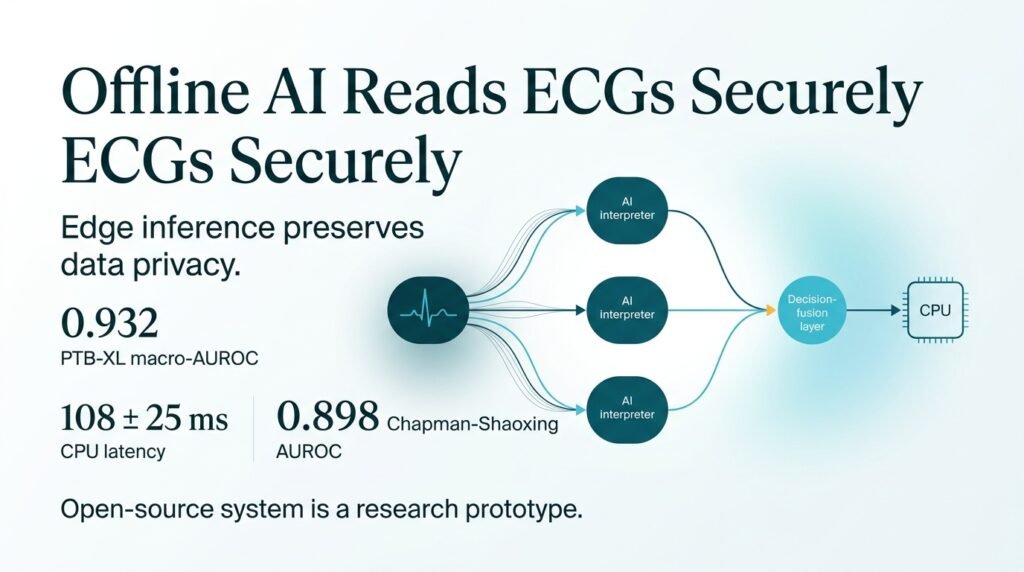
The tri-modal framework combines clinical rules, a local neural network, and a vision-language model. By running entirely on-device, it bypasses the data sovereignty issues that stall hospital adoption. Here is how the system performed across the testing cohorts:
- On the PTB-XL test set of 2,198 records, the local network achieved a macro-averaged AUROC of 0.932, matching heavy GPU-based models.
- The entire pipeline processed an ECG in just 108 ± 25 milliseconds on a standard CPU with zero network access.
- When tested without retraining on an external cohort of 1,599 patients, the model maintained a strong macro-AUROC of 0.898.
- The system filtered out noisy signals, maintaining an AUROC of 0.951 even at a harsh 5 dB signal-to-noise ratio.
The limits of agentic AI
The study also exposes a critical limitation of general-purpose AI agents. When the clinical rules and the neural network disagreed, researchers used a vision-language model to break the tie. It failed. In a pilot of 30 disagreements across 25 records, the agentic model managed an accuracy of just 0.267.
This poor performance warns against using general-purpose models for clinical decision-making. They lack the specialized training needed for cardiology. This finding supports the ongoing caution in the field regarding irrational hype in cardiac AI. Generalist models are not ready to act as autonomous medical referees.
What this changes
The weak agreement between the rules and the network, represented by a Cohen’s kappa of 0.26, is actually a clinical advantage. It means they make different mistakes, allowing them to complement each other. By fusing these distinct methods, the system catches errors that a single model would miss.
We must note that this system remains a research prototype, not a cleared medical device. It has not been tested on patient outcomes in a live clinical trial. However, the immediate takeaway for healthcare IT leaders is clear. Stop assuming that clinical AI requires expensive cloud contracts. Local, hybrid architectures are fast, secure, and ready for development.
Read the full study in Physiological Measurement.