
Hospitals cannot share patient records, but a new federated framework allows AI models to learn from clinical notes across institutions without moving a single byte of raw data.
Why does medical AI fail when it moves to a new hospital? The culprit is data hoarding. Strict privacy rules stop hospitals from pooling patient charts, leaving AI models trained on narrow, single-site data that fails in the real world.
This disconnect forces a false choice. We are told we must either compromise patient privacy to build smart models, or settle for weak AI that cannot generalize. A newly published study in npj Digital Medicine challenges this trade-off.
A decentralized learning model
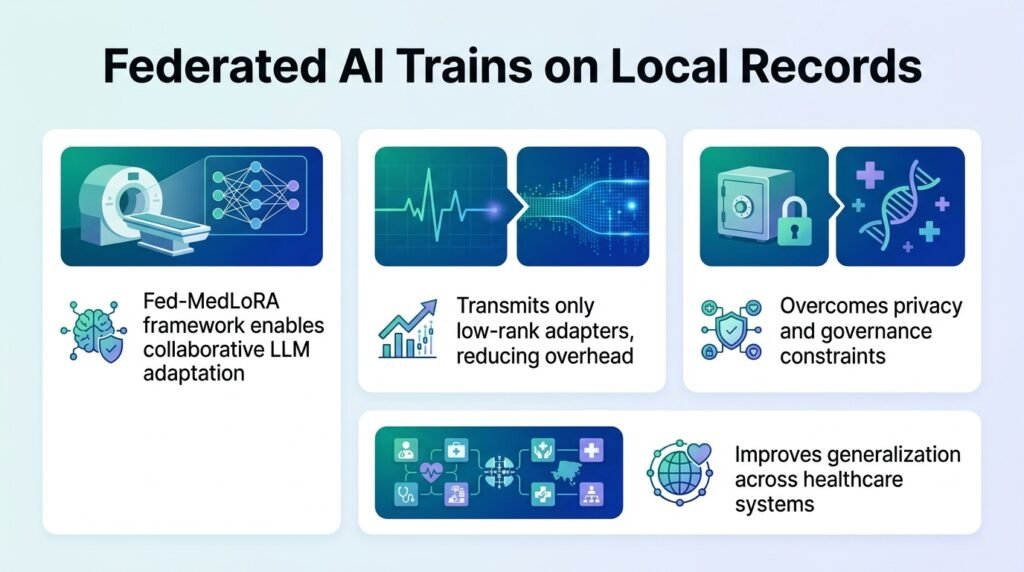
Researchers introduced Fed-MedLoRA and Fed-MedLoRA+, frameworks that train large language models across multiple hospitals. Instead of moving sensitive patient records to a central server, the model stays local. Only lightweight mathematical updates, called low-rank adapters, travel between institutions.
This approach directly addresses the bandwidth and privacy issues that plague medical networks. It builds on recent concepts in communication-efficient federated learning. By transmitting only these small adapters rather than full model weights, the system slashes communication overhead. It proves that local institutions can collaborate without exposing their proprietary data structures.
To prove the system works, the team ran a massive evaluation. They tested the framework on clinical information extraction using 5 independent patient cohorts. This benchmark included 42,198 distinct entities and 41,570 clinical relations. They also tested the system in a real-world deployment using clinical notes from the Yale New Haven Health System.
The performance trade-offs
The results show that decentralized training does not have to mean poorer performance. The framework consistently beat standard zero-shot and fine-tuned models.
- The system successfully extracted clinical data across 5 heterogeneous cohorts.
- Adaptive aggregation in Fed-MedLoRA+ resolved differences in local annotation styles and patient demographics.
- The model maintained strong performance during low-resource deployment at new, unseen hospital sites.
Yet, we must look closely at the security measures. To block hackers from reconstructing patient data from the model updates, the researchers applied Gaussian perturbation. This adds mathematical noise to the transmitted adapters.
This noise is a double-edged sword. While it guarantees privacy, adding too much noise can degrade the model’s clinical accuracy. Finding the right balance remains a delicate task for any IT department.
Why this matters
This finding matters because it shifts the bottleneck of clinical AI from data access to local computing power. Hospitals no longer need to sign risky data-sharing agreements to benefit from collaborative AI. Instead, they must invest in local hardware capable of running these federated updates.
This aligns with broader trends in trustworthy federated healthcare. The future of medical AI is not a single giant database in the cloud. It is a web of secure, local nodes learning from each other in silence.
Read the full analysis in npj Digital Medicine.