title: AI speeds up genetic testing for sick infants
An algorithm trained on electronic health records can flag critically ill newborns who need rapid gene sequencing weeks faster than human doctors alone.
In a Level IV neonatal intensive care unit (NICU), doctors face a silent enemy: time. Genetic diseases are common in these units, yet the early symptoms are often too vague for clinicians to recognize immediately. By the time a specialist is called, the window for effective intervention has often closed.
This delay is where clinical intuition fails. We traditionally treat genetic testing as a reactive tool, ordered only when a baby’s condition deteriorates. A new machine learning model challenges this paradigm by turning passive electronic health record (EHR) data into an active triage system. It forces us to rethink the entire diagnostic timeline.
Predicting the genetic bottleneck
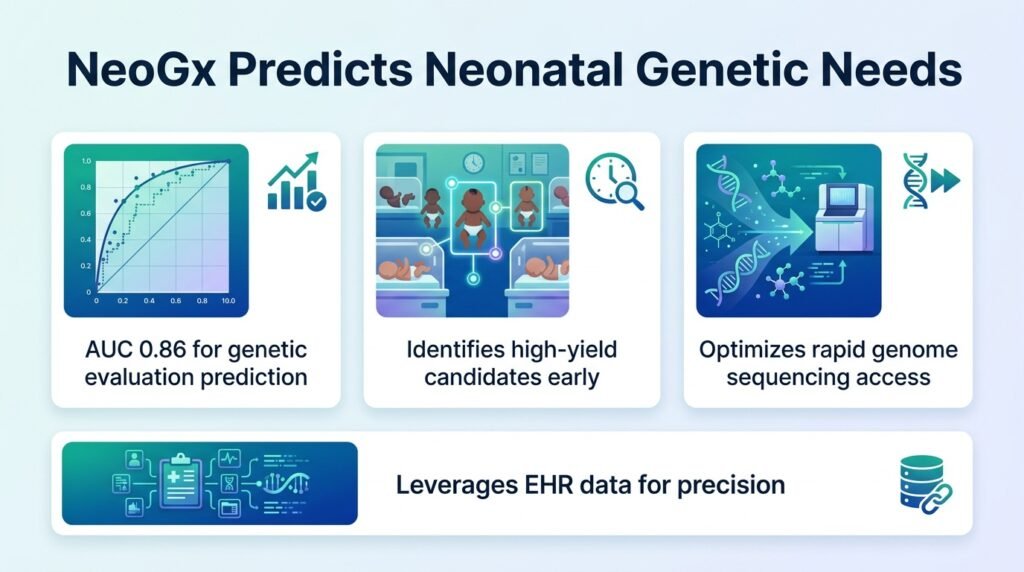
The researchers developed NeoGx to predict which infants will require a genetic evaluation within their first 18 months of life. They trained and tested the model using data from 14,272 Level IV NICU patients. This population was divided into a development cohort of 11,201 patients, a calibration cohort of 1,080 patients, and a validation cohort of 1,991 patients.
By analyzing both structured EHR data and clinical text over four weeks, the algorithm proved highly accurate. It did not wait for a doctor to suspect a rare disease. Instead, it quietly built a risk profile in the background.
The clinical impact
The real-world implications of these predictions are stark. The model successfully compressed a timeline that usually drags on for weeks.
- NeoGx achieved a ROC AUC of 0.849 and a PR AUC of 0.771.
- It reduced the average time to a first genetic evaluation from 44 to 29 days, a clinical head start of 15.2 days.
- When paired with rapid genome sequencing as the first-line test, the share of cases reaching a definitive diagnosis within 14 days rose from 9.5% to 68.6%.
This is a massive leap. While previous research has debated the clinical value of rapid sequencing, such as in Genomic sequencing in acutely ill infants: what will it take to demonstrate clinical value?, the bottleneck has rarely been the lab technology itself. The delay is almost always human. NeoGx bypasses human hesitation by flagging high-risk infants automatically.
The hurdles ahead
However, we must remain skeptical of retrospective success. The study relies on historical EHR data, which is notoriously messy and highly dependent on how individual doctors write their notes. If a hospital’s documentation habits differ from the training site, the model’s accuracy could drop.
Furthermore, a faster diagnosis only matters if the clinical system can act on it. If a hospital lacks the specialists to handle a 60% surge in early genetic cases, the bottleneck simply shifts down the line.
A prospective trial is needed to prove these time savings translate to better survival rates. But as a proof of concept, this model shows that the best way to speed up genetic medicine is not to build faster sequencers, but to build smarter clinical triggers.
Read the full study in medRxiv.