
Generative AI can draft full clinical examination stations in a single prompt, but clinical accuracy gaps require strict expert oversight.
Building Objective Structured Clinical Examinations (OSCEs) drains hundreds of faculty hours every academic year. Medical schools must create detailed candidate instructions, standardized patient scripts, and examiner rubrics for every testing scenario. Automating this pipeline promises to cut administrative burnout, but only if the generated clinical logic holds up under scrutiny.
A study published in npj Digital Medicine shows that large language models can produce schema-validated, full-station OSCE cases from a single structured call. However, expert reviewers noted key variances in clinical accuracy that prove software is not ready to replace faculty judgment.
Testing complete clinical stations
Researchers built an LLM-based system to generate end-to-end medical exam scenarios. To test the software, three board-certified internists evaluated 24 generated cases spanning eight internal medicine diagnoses across three distinct learner levels.
The reviewers rated the synthetic materials using a 12-item Likert instrument to assess educational structure, realism, and medical alignment.
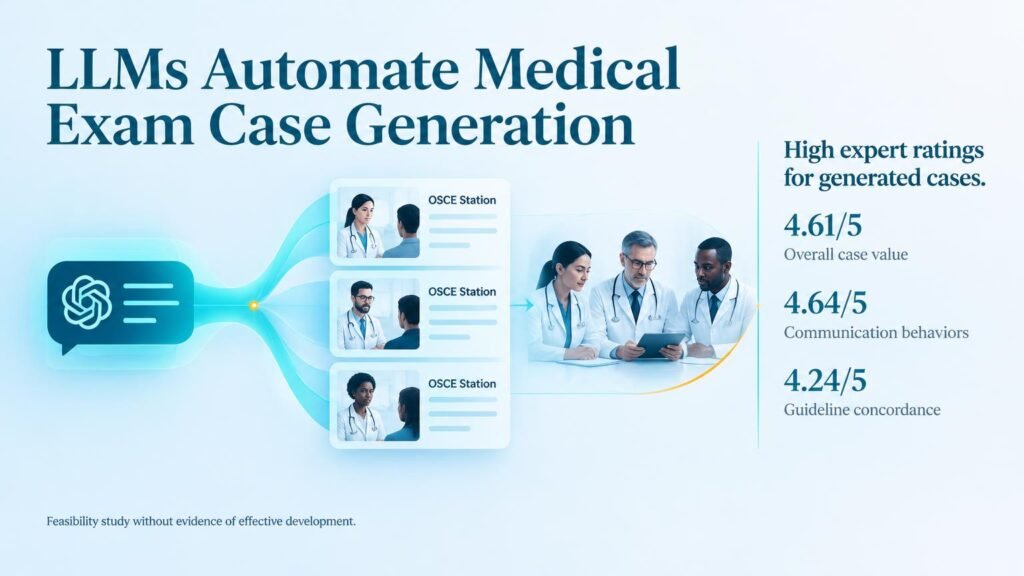
- Communication behaviors earned the highest rating at 4.64/5.
- Entrustable Professional Activity (EPA) alignment reached 4.62/5.
- Overall educational value scored 4.61/5.
- Guideline concordance scored lowest at 4.24/5 and showed the largest rater disagreement.
The lower score for clinical guidelines exposes the core operational bottleneck. While the AI successfully mimics proper exam formatting and communication style, it still stumbles on strict medical accuracy.
That subtle gap is where patient safety risks hide.
Moving past basic drafting
These findings fit into a broader push to bring generative software into medical training. Recent synthesis work mapping LLM usage in undergraduate medical education shows rapid adoption, but highlights persistent issues with clinical accuracy. Similarly, testing across different GPT-4o configurations for OSCE generation proves that model setup heavily influences test reliability.
The study establishes reproducible infrastructure for automated test creation, but it does not prove these cases improve student outcomes or lower long-term costs. Because this was a small feasibility trial, the results cannot guarantee that AI-generated stations match human-written exams in live testing environments.
Medical schools can safely use these tools to generate first drafts and save initial writing time. However, faculty must carefully review every clinical guideline before any AI-generated scenario reaches a live student examination.
Read the full study in npj Digital Medicine.