
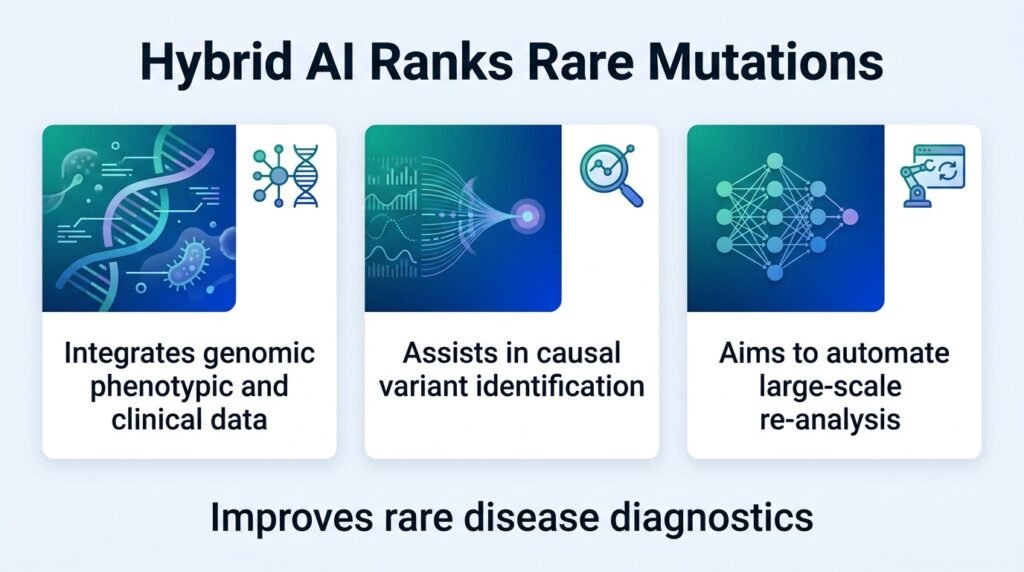
A new ensemble AI cuts through genomic noise to find rare disease mutations, shifting the burden of diagnostics from human experts to automated systems.
Sequencing a genome is now cheap and fast, but finding the single genetic typo causing a rare disease among tens of thousands of harmless variants remains a manual bottleneck. Why are we still relying on human experts to click through databases one by one? This manual search is where diagnostic pipelines stall.
The launch of aiDIVA suggests we are finally moving past simple pathogenicity scores that only predict if a protein is broken. It proves that the future of diagnostics belongs to ensemble models that combine raw genetics, clinical records, and language models to explain their decisions, rather than single-algorithm predictors.
How the model works
The tool combines a random forest machine learning model with large language models to analyze genomic and phenotypic data. It generates evidence-based scores for both dominant and recessive diseases and integrates clinical metadata to rank variants. This builds on earlier frameworks like eDiVA, which focused on basic variant prioritization, and newer tools like Xrare that model phenotypes alongside genetic evidence.
By using multiple layers of AI, the system does not just flag mutations. It explains why a specific variant matches the patient’s symptoms. This addresses a major complaint of clinical teams who distrust “black box” algorithms that offer no reasoning for their predictions.
The performance metrics
The researchers tested the ensemble model, called aiDIVA-meta, across two distinct patient cohorts to see if it could surface the correct causal variant.
- It placed the true causal variant in the top three candidates for 97.4% of patients in a pre-training cohort with known ClinVar or HGMD evidence.
- It maintained a 93.3% accuracy rate in the top three for a post-training cohort featuring previously unreported genetic variants.
This high level of accuracy across both known and unknown variants is crucial. It suggests the model is not just memorizing existing databases but is learning the underlying rules of genetic pathology.
The diagnostic reality check
These numbers are impressive, but the 4.1% drop in performance on previously unreported variants highlights a persistent challenge. AI models still rely heavily on existing medical literature. When a mutation has never been documented in scientific papers, the system’s predictive power degrades.
In rare disease diagnostics, the sheer volume of variants of uncertain significance paralyzes clinical decision-making. By consistently placing the true causal variant in the top three, even for novel mutations, aiDIVA reduces the search space by orders of magnitude. This specific finding matters because it proves that clinical metadata, when processed via ensemble machine learning, can compensate for a lack of historical genetic data.
This means AI cannot fully replace clinical geneticists yet. Instead, it serves as a highly efficient filter, reducing a list of thousands of variants to three likely targets. The real test will be how well clinical laboratories integrate these hybrid workflows into daily practice without creating new bottlenecks. Clinicians must still validate these top-three suggestions, meaning human expertise remains the ultimate bottleneck.
Read the full study in npj Genomic Medicine.