

Hospital size and location dictate whether Medicare reimburses AI stroke tools, not patient illness severity.
Where a patient suffers a stroke determines whether AI helps diagnose it, regardless of how severe their symptoms are. Federal incentives were designed to speed novel software into emergency rooms. Yet claims data shows large, well-resourced institutions capture the reimbursement while community hospitals lag behind.
This disconnect challenges the idea that Medicare’s New Technology Add-On Payment program automatically democratizes access to care. When NTAP was approved for stroke AI, supporters hoped financial incentives would drive broad clinical adoption. Instead, facility capacity remains the main gatekeeper.
Where the Money Goes
An analysis of 2,116 acute ischemic stroke episodes across 1,076 facilities from October 2020 to December 2023 evaluated how centers billed Medicare for AI software that detects large vessel occlusions. The findings show clear institutional patterns in adoption:
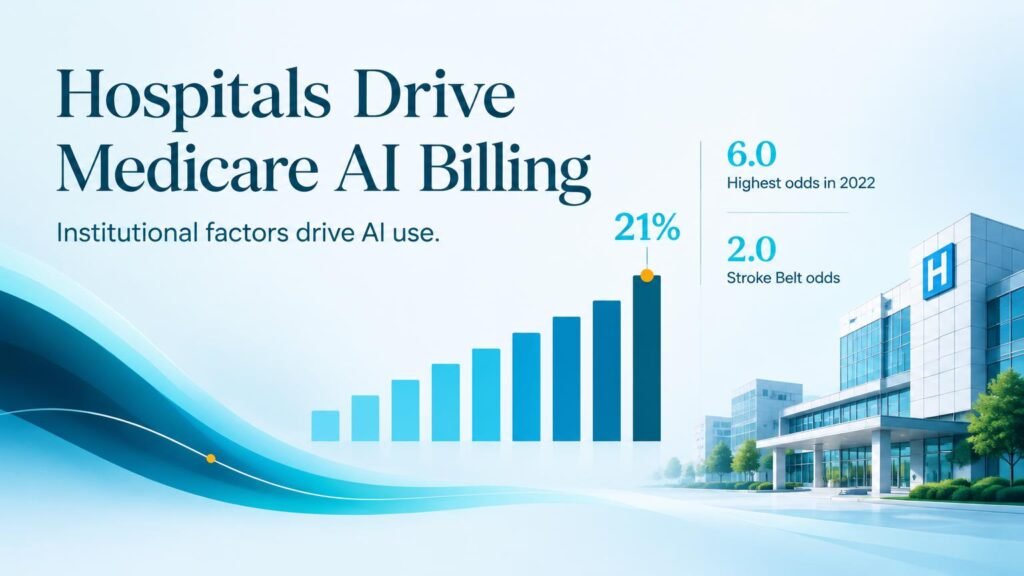
- Billed AI use peaked at 21% of eligible inpatient stroke episodes requiring thrombolytic treatment in 2022.
- Patients in the Stroke Belt had twice the odds of receiving NTAP-billed AI care (OR 2.0, 95% CI 1.3–3.0).
- Comprehensive stroke centers showed significantly higher billing odds (OR 1.5, 95% CI 1.1–2.0) compared to smaller facilities.
- The highest adoption occurred in hospitals with 1,000 or more beds and episodes involving CT imaging.
- Patient demographics, area deprivation, and clinical stroke severity showed no statistically significant association with AI billing.
Facility Size Outweighs Need
The data shows that clinical urgency is not what drives billing for these digital triage tools. Adoption peaked in 2022, reaching six times the baseline odds of late 2020 (OR 6.0, 95% CI 2.7–13.3). That jump reflects rapid corporate integration by major health systems rather than targeted deployment for the sickest patients.
That distinction matters for health system leaders and policy makers. The NTAP framework assumes that reimbursement follows clinical utility. In practice, large centers with dedicated IT infrastructure and established coding teams are simply better equipped to submit claims for billing code 4A03X5D. Smaller sites that treat severe strokes without advanced center status miss out on supplemental funding.
Limitations and Reality
This study measures billing claims, not clinical efficacy or diagnostic accuracy. Standard Medicare claims files do not track whether AI triage actually reduced time-to-treatment or improved long-term neurological outcomes. Furthermore, hospitals using AI software without billing Medicare under NTAP are missed entirely in this dataset.
For healthcare leaders, the takeaway is operational rather than clinical. NTAP reimbursement alone will not spread diagnostic algorithms to under-resourced emergency departments. Closing regional care gaps requires addressing facility-level infrastructure barriers, not just adding supplemental codes to Medicare fee schedules.
Read the full study in the American Journal of Neuroradiology.