 Yusuf Yesil, MD, MIS
Noise carries critical risk signals
Labor wards often dismiss gaps in electronic fetal monitoring as minor hardware glitches. Clinical teams adjust sensors or wait out signal drops, assuming missing traces hide nothing of value. That assumption is dangerous.
A multicenter observational trial reveals that signal loss itself signals metabolic stress. High dropout rates during internal fetal scalp electrode monitoring indicate elevated risk for sustained birth asphyxia, proving that missing data functions as an active warning sign rather than an annoying artifact.
This finding complicates how engineers build predictive labor models. Standard algorithms often clean or discard noisy readings before scoring risk. Removing missing segments strips away vital clinical evidence, potentially missing fetal distress when every minute matters.
High dropout triples asphyxia likelihood
Researchers analyzed 46,662 labor episodes at 36 weeks or greater across three international cohorts. The model-development set included 32,242 episodes from Australian tertiary centers, alongside external validation sets of 548 episodes from the Czech CTU-UHB database and 13,872 episodes from Australian community hospitals. In the primary cohort, 860 births (2.67%) met Delphi-consensus criteria for sustained perinatal asphyxia.
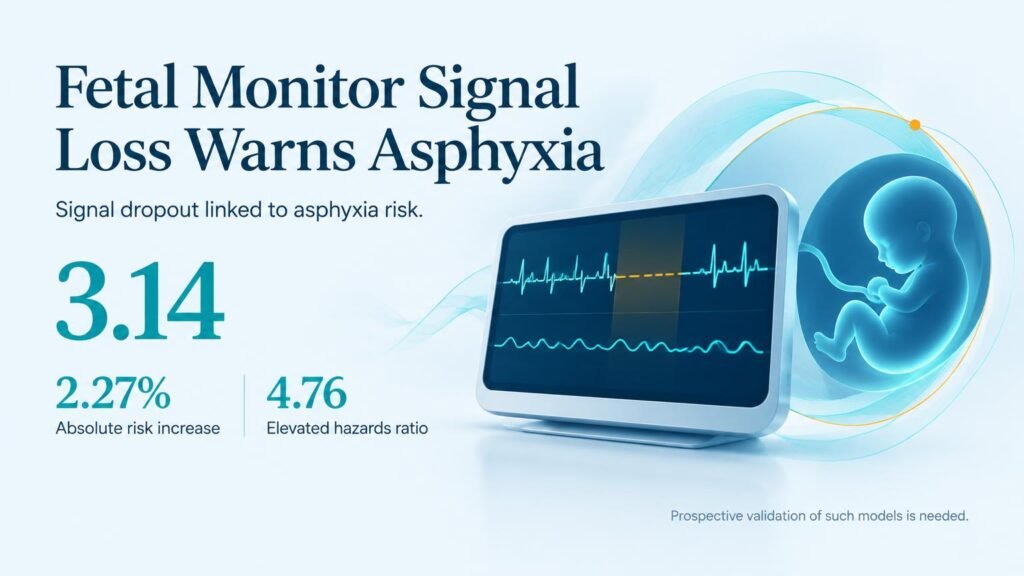
Compared to low Doppler ultrasound dropout, internal scalp ECG with high dropout (over 30% signal loss) showed a strong association with asphyxia. IPW-adjusted odds ratios reached 3.14, while TMLE-adjusted odds ratios hit 2.08. This represents an absolute risk increase of 2.27%, or one additional case of asphyxia for every 44 births exhibiting high ECG signal loss. Longitudinal survival analysis supported these elevated hazards with a hazard ratio of 4.76.
While previous work published in Best Practice & Research Clinical Obstetrics & Gynaecology focused on classic pattern interpretation, these findings align with recent multicohort evidence in npj Digital Medicine showing that missing electronic monitoring signals directly alter risk profiles.
Retrospective data limits immediate adoption
This observational data does not prove that missing signals cause poor outcomes or that swapping sensors will prevent injury. Fetal movement, scalp edema, and uterine hyperstimulation frequently disrupt electrical contact during severe stress, creating confounding clinical noise.
Because the retrospective design relies on routinely recorded data, effect estimates varied across external validation cohorts. Clinical units must treat high internal sensor signal loss as an urgent cue to evaluate the fetus directly, rather than waiting for clean data to appear. Software developers must retain mode-specific dropout as a primary predictive feature rather than filtering it out during data preprocessing.
Read the original research study published in the International Journal of Gynecology & Obstetrics.