 Yusuf Yesil, MD, MIS
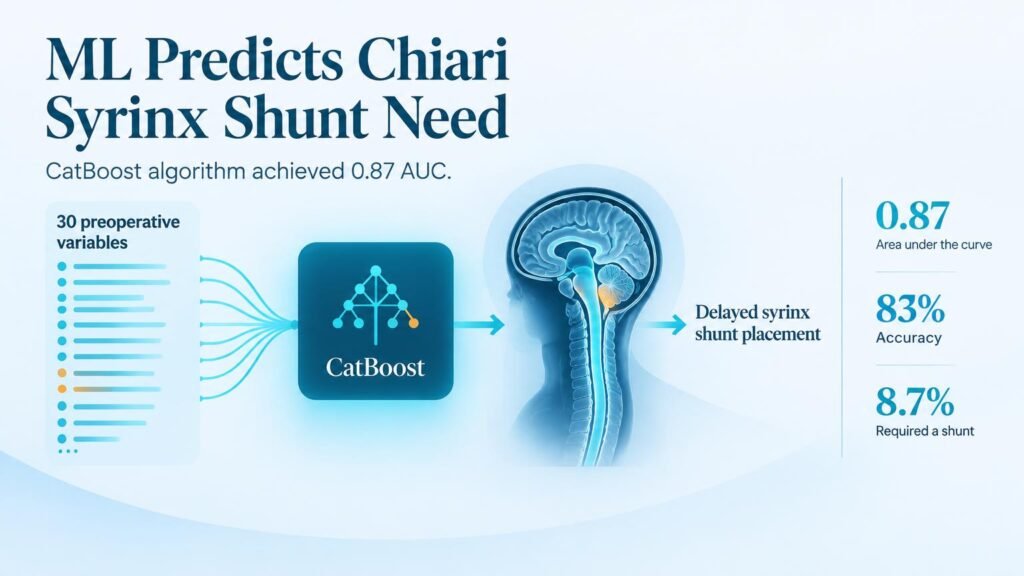
Surgeons performing posterior fossa decompression (PFD) for Chiari malformation type I (CM-I) with syringomyelia often operate under a cloud of uncertainty. While PFD aims to restore normal cerebrospinal fluid flow, a fraction of patients experience persistent or worsening fluid cavities, ultimately requiring a syrinx shunt. A new study shows that predictive software can flag high-risk patients before the first incision, shifting post-op care from reactive monitoring to proactive surgical planning.
Rather than relying on post-hoc clinical intuition, researchers tapped real-world data to identify who will fail primary decompression. The finding challenges the traditional wait-and-see approach, proving that surgical timing is a major controllable risk factor for secondary failure.
Predicting Secondary Failure
Analyzing the TriNetX network from 2010 to 2020, researchers tracked 3,112 patients (62.3% female, median age 28.4 years) undergoing index PFD with a median follow-up of 5.1 years. Within this cohort, 271 patients (8.7%) developed refractory syringomyelia requiring syringosubarachnoid, syringopleural, or syringoperitoneal shunts. Five supervised algorithms were trained on 30 preoperative variables using synthetic over-sampling to handle outcome imbalances.
The CatBoost model outperformed rival algorithms on the independent validation set. Key performance metrics include:
- 0.87 Area Under the Curve (AUC) demonstrating high discriminative capacity.
- 83% overall accuracy across validation testing.
- 0.78 sensitivity and 0.82 specificity for identifying shunt conversion.
This work expands on earlier prognostic research, such as points-based outcome algorithms for CM-I adults and recent efforts applying machine learning for 30-day post-PFD outcomes.
Key Surgical Drivers
Shapley Additive Explanations (SHAP) highlighted four primary risk factors for secondary shunting: adolescent idiopathic scoliosis, prolonged symptom duration, age over 40 years, and preoperative opioid dependency. Scoliosis and age point to underlying structural and tissue compliance issues that standard decompression fails to fix.
The most striking clinical finding came from partial dependence analysis. Every 1-month delay in surgical intervention raised the absolute probability of requiring a syrinx shunt by 0.8% to 1.0%.
That timing penalty is severe.
Waiting six months to operate can boost a patient’s absolute risk of secondary shunt placement by up to 6%. Delaying intervention lets spinal cord damage solidify, rendering standard posterior decompression far less effective.
Clinical Realities and Limits
The operational takeaway is straightforward. Clinicians should use risk stratification to expedite primary surgery for patients presenting with scoliotic deformities or long-standing symptoms, while scheduling aggressive long-term imaging surveillance for high-risk individuals.
However, the study relies on retrospective database coding via TriNetX. It lacks granular anatomical metrics, such as baseline syrinx volume or specific posterior fossa dimensions, which are critical to surgical decisions. Algorithms trained on diagnostic billing codes cannot replace detailed magnetic resonance imaging analysis.
Retrospective validation on administrative data does not guarantee clinical benefit. Prospective trial validation must prove that software-guided surgical timing actually prevents secondary operations before routine adoption.
Read the complete research in the Journal of Neurosurgery Spine.