
Radiologists reading chest scans must now measure the aorta faster without losing diagnostic precision.
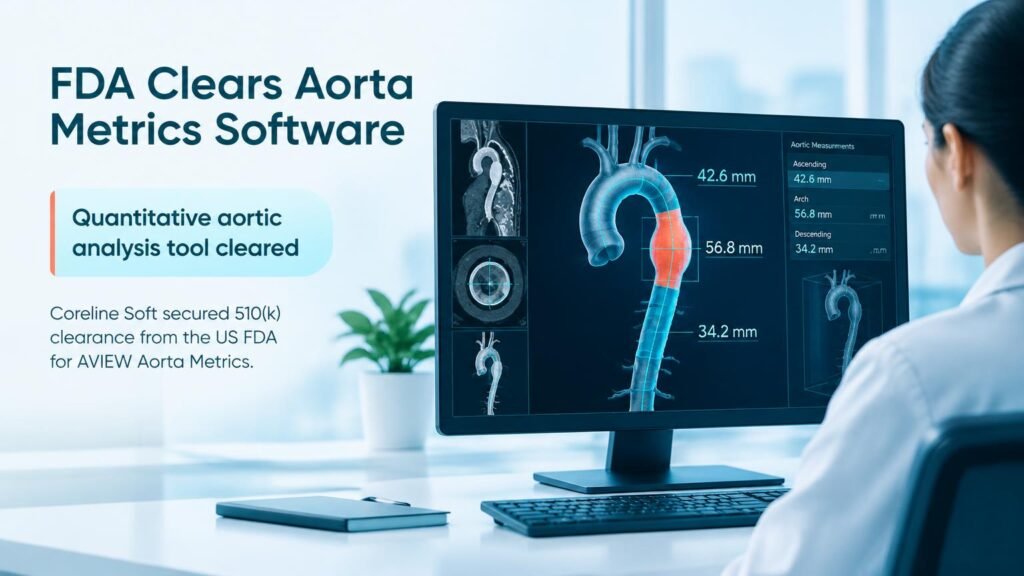
Automating aortic diameter measurements across anatomical zones shifts chest CT analysis from single-disease screening to multi-organ evaluation. Coreline Soft secured 510(k) clearance for AVIEW Aorta Metrics, adding cardiovascular measurements to an AI suite already targeted at lung nodules and emphysema.
Workflow Over Replacement
Measuring aortic dimensions manually consumes critical reader time during routine chest imaging. Automated segmentation reduces manual tracing, but clearance alone does not prove improved patient outcomes. 510(k) clearance establishes substantial equivalence, not clinical efficacy.
Integration remains the true hurdle for hospital adoption. By embedding analysis into existing PACS networks through zero-click workflows, software providers aim to minimize friction. Yet, retrospective accuracy does not guarantee seamless performance across diverse patient populations or varied scanner hardware.
The Operational Reality
Health systems should evaluate whether automated aortic tracking actually reduces diagnostic turnaround times before scaling deployment. Software clearance expands analytical capacity, but clinical oversight remains mandatory.