

Two hidden biological paths cause identical Parkinson’s symptoms.
A new proteomic analysis reveals why Parkinson’s drug trials keep failing despite using biologically pure patient groups.
How can two patients with the exact same tremors, the exact same brain scans, and the exact same disease progression be suffering from two completely different biological crises?
This is the “clinical masking effect.” It explains why promising Parkinson’s drugs repeatedly fail in clinical trials. The patients look identical on the outside, but their brains are failing for entirely different reasons.
For years, researchers thought that grouping patients by a single biological marker, like the alpha-synuclein protein, would create a clean testing pool. This study shatters that assumption. It proves that even within a biologically “pure” group, the underlying disease pathways can be diametrically opposed. If you test a drug that targets lysosomal repair on a group where half the patients actually have synaptic failure, your trial is mathematically doomed to fail.
Two hidden biological crises
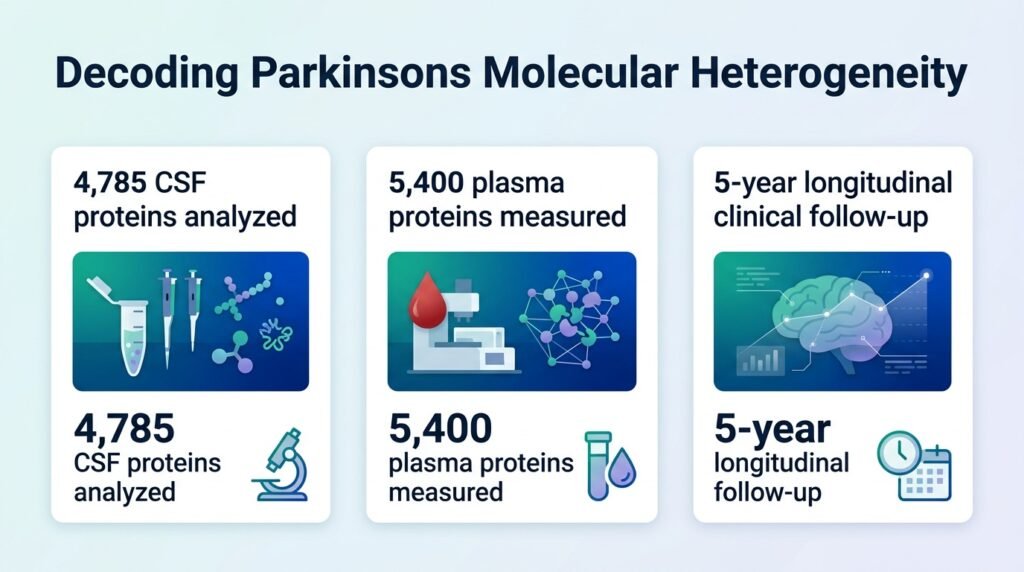
Researchers analyzed **114** patients who all tested positive on the alpha-synuclein seed amplification assay (SAA). They tracked these patients over **5** years, analyzing **4,785** cerebrospinal fluid (CSF) proteins and **5,400** plasma proteins. This deep dual-compartment proteomics approach allowed them to see past the outward symptoms.
The unsupervised machine learning model split the cohort into two distinct biological subtypes. One group suffered from synaptic and neuronal failure. The other experienced lysosomal and glial collapse. Yet, their physical symptoms, DaTscan brain profiles, and 5-year disease trajectories were completely indistinguishable. This divergence occurred entirely independently of known genetic mutations.
A new blood test
To bypass this clinical disguise, the researchers developed a non-invasive blood panel. They selected five specific plasma proteins: **FAM3B, ACTA2, ATL3, PEBP4, and BTNL10P**.
This machine-learning panel sorted the patients with a cross-validated Area Under the Curve (AUC) of **0.867**. When tested against a large-scale multi-center replication dataset, the panel successfully pulled the hidden biological signals out of the noisy clinical data. It proved that these critical peripheral biomarker signals are completely submerged in unstratified clinical cohorts.
Key trial insights
- The cohort of **114** patients showed identical clinical progression despite deep biological differences.
- The analysis mapped **4,785** CSF and **5,400** plasma proteins to identify the two distinct disease subtypes.
- The 5-protein blood panel achieved an AUC of **0.867** in identifying these hidden patient groups.
The study is limited by its relatively small discovery cohort of **114** patients, though the researchers validated the findings in a larger multi-center dataset. Additionally, while the 5-protein panel is highly accurate, we still do not know if treating these subtypes differently will actually improve clinical outcomes.
This framework challenges the pharmaceutical industry to stop treating Parkinson’s as a single disease. Until clinical trials stratify patients by these deep molecular profiles, drug developers will continue to drown real therapeutic signals in statistical noise.
Read the full study in npj Parkinson’s Disease.