

Clinicians can skip expensive, invasive scans and still predict Alzheimer’s progression with high accuracy by prioritizing cognitive testing in machine learning models.
Healthcare systems waste millions of dollars on PET scans and spinal taps to predict if mild cognitive impairment will progress to Alzheimer’s disease. A new ablation study of 2,430 patients from the Alzheimer’s Disease Neuroimaging Initiative challenges this high-tech obsession. The analysis reveals that simple cognitive tests are the true workhorses of predictive AI, while expensive biomarkers add surprisingly little value.
This finding complicates the industry push for complex diagnostic pipelines. It suggests that clinical workflows can be simplified and cheapened without sacrificing predictive power. For years, the field has chased expensive biological signatures to prove software works, but the active ingredient in risk prediction is already in the patient’s chart.
The cost of complexity
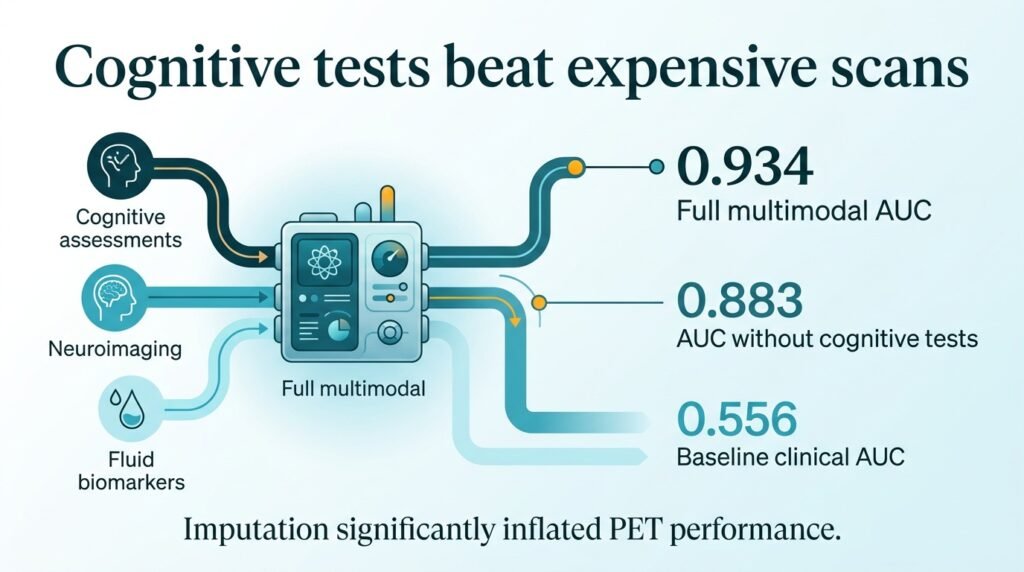
The researchers trained XGBoost models to predict 24-month progression. The full multimodal model achieved an impressive AUC of 0.934. However, when researchers stripped away cognitive assessments, performance plummeted to 0.883. This was the single largest drop in the study, proving that cognitive data is irreplaceable.
In contrast, removing genetic data, spinal fluid tests, or structural MRIs barely budged the needle. This aligns with other efforts to streamline diagnostics, such as using quadruple biomarker combinations to find efficient pathways for early detection. The marginal gains of invasive tests do not justify their high cost and patient burden.
- Full multimodal model: AUC of 0.934
- Without cognitive assessments: AUC dropped to 0.883
- Without genetic data (APOE): AUC of 0.933
- Without spinal fluid (CSF): AUC of 0.931
- Without structural MRI: AUC of 0.932
- Baseline demographics-only model: AUC of 0.556
The researchers uncovered a critical catch regarding PET scans. Removing PET scans only dropped the AUC to 0.932 in the primary analysis, but complete-case analysis showed that data imputation artificially inflated its apparent value (P=0.005). This means PET’s actual contribution is likely even lower and highly unstable in real-world settings. Instead of rushing patients to imaging suites, clinics should focus on standardized, high-quality cognitive testing. This is highly relevant as researchers explore alternative digital markers, such as integrating virtual reality with MRI to catch early decline.
Real-world limitations
We must treat these retrospective findings with caution. The data comes from a highly curated research cohort, which does not reflect the messy reality of typical community clinics. Furthermore, the baseline clinical model using only basic demographics performed near chance at an AUC of 0.556, proving that demographics alone are useless.
The practical takeaway is clear. Healthcare payers and providers should resist the urge to mandate full biomarker panels for routine risk stratification. Start with cognitive tracking, and reserve invasive tests for ambiguous cases.
This study was published in medRxiv.