Machine learning models show that older adults with the lowest baseline risk of bleeding face the highest relative increase in harm from daily aspirin.
Guidelines routinely discourage daily low-dose aspirin for primary prevention in healthy older adults. Yet millions of seniors continue taking the medication without a clear clinical indication. Clinicians often tolerate this habit under the assumption that low-risk patients face negligible harm. A new machine learning analysis turns that safety assumption on its head.
That disconnect exposes a critical blind spot in routine preventative care.
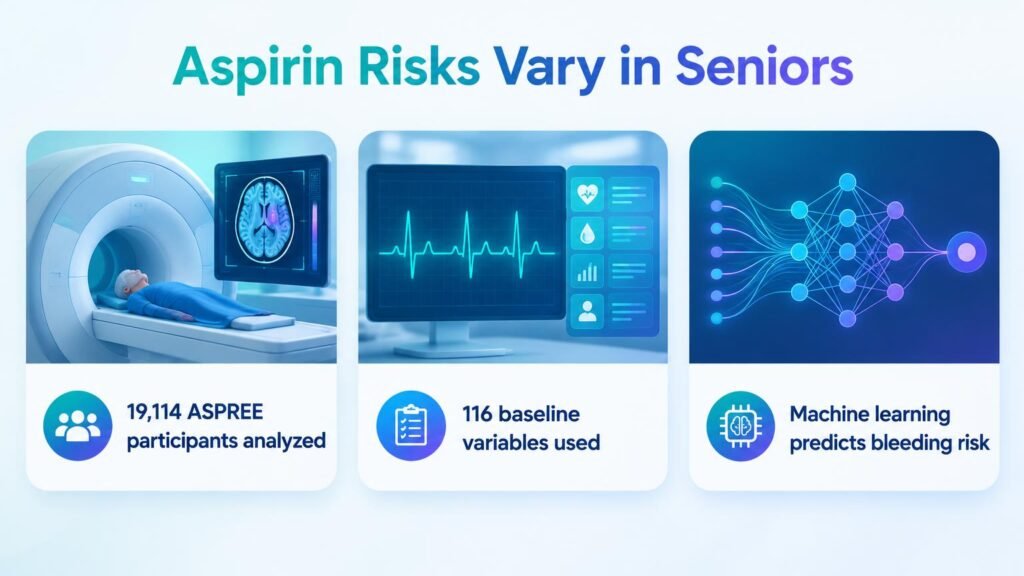
Researchers analyzed data from 19,114 older adults enrolled in the ASPREE trial using 116 baseline variables. They trained random forest and random survival forest algorithms to predict five-year major bleeding risks over a median follow-up of 4.7 years. During the study, participants experienced 626 major bleeding events. The primary random forest model demonstrated moderate discrimination with an area under the curve (AUC) of 0.65 and strong calibration with a Brier score of 0.032.
Unexpected Risk Patterns
The models stratified participants into low, intermediate, and high-risk tiers using the 20th and 80th percentiles of predicted risk. Counterintuitively, the relative danger of aspirin therapy was concentrated among patients deemed least vulnerable at baseline.
Low-risk seniors prescribed aspirin experienced more than double the relative hazard of major bleeding compared to non-users. This relative increase was far steeper than the risk observed in higher-tier groups.
- 2.26 subdistribution hazard ratio for major bleeding in the lowest baseline risk group.
- 1.17% absolute risk difference in five-year cumulative bleeding for low-risk participants taking aspirin.
- No statistically significant difference in absolute risk across risk tiers (Cochran’s Q p > 0.45).
Why Absolute Risk Matters
Proportional risk jumps sound alarming, but absolute trade-offs dictate frontline clinical practice. On the absolute scale, low-risk participants taking aspirin faced an added 1.17% five-year risk of major bleeding. Across the entire cohort, absolute risk differences between risk groups did not achieve statistical significance.
This distinction changes how health systems should approach automated risk scores. High relative hazard spikes in low-risk patients do not mean low-risk patients suffer the most bleeding overall. Algorithms that flag relative risk spikes without context risk confusing clinicians who need simple net-benefit calculations.
Model Limits and Takeaways
An AUC of 0.65 confirms that tree-based algorithms still struggle to isolate individual bleeding trajectories in complex older populations. Unmeasured biological factors and lifestyle variables leave substantial uncertainty in these predictions. Furthermore, retrospective trial data cannot prove that AI-guided deprescribing directly improves clinical outcomes.
The practical message for clinicians is clear. Low baseline risk is not a green light to maintain unindicated aspirin, as even low-risk patients suffer a clear absolute bleeding penalty. Deprescribing initiatives should target unindicated aspirin use across all risk categories rather than delaying action for low-risk seniors.
Read the full preprint in medRxiv.