
Title: AI outscores human grading for kidney cancer survival
A new AI model predicts kidney cancer survival better than the gold-standard human grading system.
Pathology has a consistency problem. Put the same kidney tumor slide in front of three pathologists, and you will often get different nuclear grades. This subjectivity directly impacts how we estimate patient survival and plan treatments.
A new study challenges the supremacy of the WHO/ISUP grading system, the current clinical gold standard. By bypassing human-defined grading categories, AI is proving that our traditional classification systems might actually be holding back prognostic accuracy.
Mapping the microenvironment
Researchers built a diagnostic framework using the Prov-GigaPath foundation model. They trained and validated it on a massive dataset of 11,135 whole-slide images from 7,033 patients across four medical centers and two public cohorts. This scale addresses the common fragility of narrow AI models.
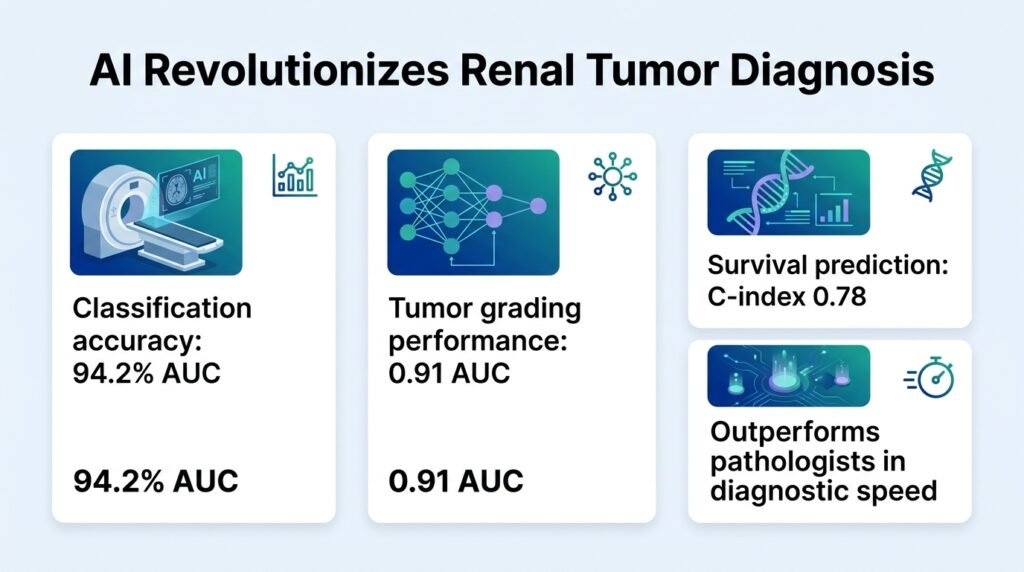
The system did not just classify tumors; it mapped the entire tissue microenvironment. It identified normal tissue with an area under the curve (AUC) of 0.990, tumor tissue at 0.982, and necrosis at 0.994. Crucially, it flagged sarcomatoid differentiation at 0.967 and pseudocapsule tissue at 0.990, features that are notoriously easy to miss but critical for surgical planning.
Better than human grading
For nine major subtypes of renal cell tumor, the model hit classification AUCs between 0.956 and 0.998. It also predicted WHO/ISUP nuclear grades for clear cell and papillary renal cell carcinoma with an AUC of 0.867.
But the real shift is how it handles prognosis. The AI generated a pan-renal risk score that predicted overall survival better than traditional WHO/ISUP grading (p < 0.001). This confirms a growing trend in computational pathology: machines see prognostic signals in tissue architecture that humans cannot categorize. This builds on earlier work in deriving prognostic features via graph deep learning and validating informatics pipelines for renal subtypes.
Why this matters
This finding matters because it decouples prognosis from human-centric grading. For decades, we forced continuous biological risks into discrete, subjective grades. This study suggests we should stop trying to make AI replicate human grading. Instead, we should let AI generate its own risk scores directly from the tissue.
By shifting from classification to direct risk scoring, clinicians get a more precise survival outlook. This could prevent the over-treatment of indolent tumors and catch aggressive cases earlier.
The reality check
Despite the impressive numbers, we must acknowledge the limits. This was a retrospective study. Pathologists did not use this tool in real-time clinical workflows to make treatment decisions.
Before this can change clinical practice, we need prospective trials. We must see if integrating this tool actually improves pathologist speed and patient outcomes in busy hospital wards.
- Dataset size: 11,135 whole-slide images from 7,033 patients.
- Subtype accuracy: AUC of 0.956 to 0.998 across nine major tumor subtypes.
- Prognostic power: Pathological risk score outperformed WHO/ISUP grading (p < 0.001).
Read the full study in BMC Medicine.