

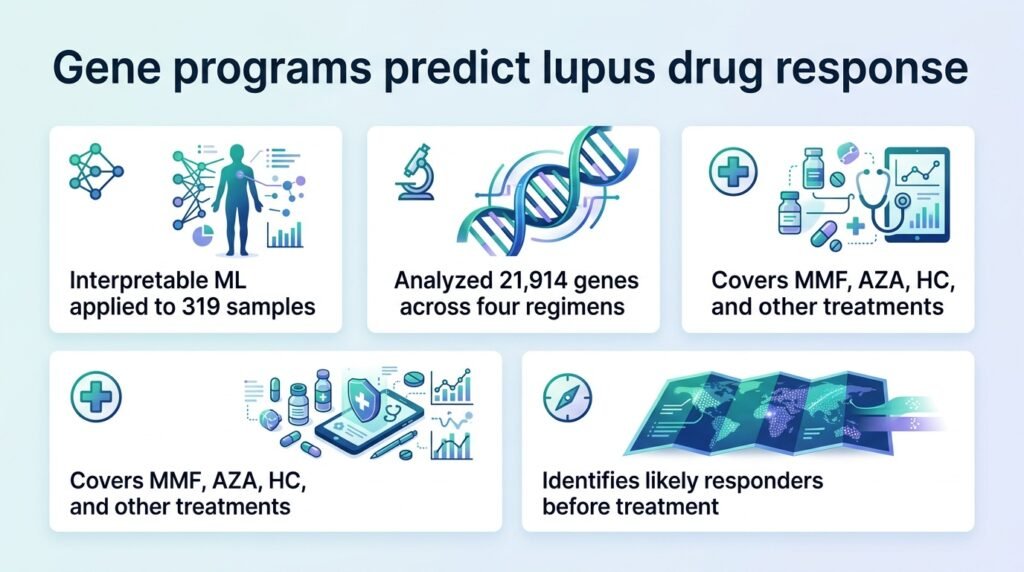
A new machine learning analysis shows that a patient’s response to lupus nephritis drugs can be predicted by tracking as few as five genes.
Why do so many late-stage clinical trials fail? It is often not because the drug is biologically flawed, but because researchers recruit the wrong patients. For lupus nephritis, a severe kidney complication, matching the right patient to the right drug has long been a guessing game.
This study challenges the traditional way we look at genetic biomarkers. Instead of looking at thousands of active genes, we only need to look at a handful of highly stable gene programs. This means clinical trials can screen patients before they enroll, saving millions of dollars and preventing patients from taking toxic drugs that will not work for them.
Predicting drug response
Researchers analyzed gene-expression data from 319 samples across 21,914 genes. They looked at four common treatments: mycophenolate mofetil (MMF), azathioprine (AZA), hydroxychloroquine (HC), and standard of care (SOC). By focusing on these cohorts, they built compact programs of just 5 to 10 genes to separate responders from non-responders.
- An AUROC of 0.866 for AZA and 0.847 for MMF, showing high predictive accuracy.
- A much lower AUROC of 0.718 for HC and 0.623 for SOC.
- Standard of care performance near chance, with a Matthews Correlation Coefficient of 0.119 and balanced accuracy of 0.555.
- Removing just one gene, TUBB2A, from the MMF program slashed its AUROC by 0.17.
Rethinking genetic signals
The real surprise lies in how unstable traditional gene lists are. The reconstructed counts of significant genes differed wildly from previously published analyses. For instance, AZA showed 4,455 significant genes compared to the published 157, while MMF showed 222 compared to 46. Conversely, HC had only 6 versus 24, and SOC had 5 versus 11.
Yet, despite these massive discrepancies, the machine learning programs remained highly stable and predictive. This suggests that the sheer number of active genes is a poor proxy for how well a patient will respond to treatment. Instead of chasing massive lists of genes, researchers must focus on these tightly coupled, small gene programs.
This builds on earlier efforts to identify disease-defining hub genes to predict treatment response. Other researchers have also explored how lactate-related gene profiles correlate with immune characteristics in lupus nephritis.
The limits of prediction
There are clear boundaries to this approach. The model failed to predict responses for standard of care and hydroxychloroquine with high accuracy. This tells us that some drug responses are not transcriptionally driven. If a drug’s response landscape cannot be mapped to gene expression, using genetic screening for clinical trials in those specific regimens will fail.
Furthermore, while 13 cross-treatment enrichment relationships remained significant, the response landscapes are highly treatment-specific. A predictive program for MMF cannot simply be copied and pasted for AZA. Drug developers must build unique models for every single therapy they test.
Read the full study in medRxiv.