A new deep learning model proves that combining visual breathing patterns with heart scans can predict which emergency patients will need a hospital bed.
Emergency room triage is a high-stakes guessing game played under intense pressure. Nurses must quickly sort patients who can safely go home from those who require immediate admission. Traditional scoring systems often miss subtle, overlapping physiological warning signs that develop right in front of them.
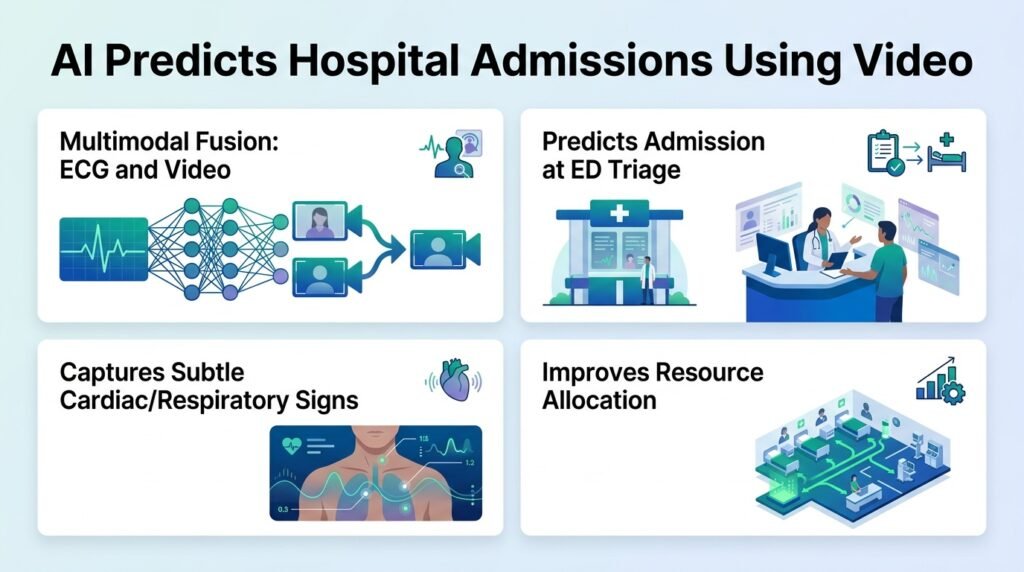
A prospective study published in BioData Mining suggests a different approach. Researchers built a deep learning model that analyzes two raw, unstructured inputs collected at triage: paper ECG images and short videos of a patient breathing. This shifts the clinical focus from manual data entry to passive, multimodal observation.
This approach challenges the status quo of relying solely on structured, numerical triage scores like the Taiwan Triage Acuity Score. Instead of waiting for blood tests, the AI extracts cardiopulmonary features directly from what is already happening in the triage bay. It suggests that the future of risk stratification lies in raw physical signals, not just administrative questionnaires.
How the model performed
The prospective trial evaluated 118 adult patients at a tertiary medical center, where the baseline hospital admission rate was 27%. The fusion model combined an ECG branch using transfer learning with a custom pipeline that estimated respiration signals from video. By applying a spatial attention module and class-balanced loss, the system successfully mapped physical cues to clinical outcomes.
The multimodal system outperformed standard triage protocols across every metric:
- An overall accuracy of 0.814 and an F1-score of 0.680.
- An area under the receiver operating characteristic curve (AUROC) of 0.863.
- A recall of 0.749 paired with a precision of 0.635.
- An area under the precision-recall curve (AUPRC) of 0.675.
Why the details matter
The real value here is interpretability. Using score-class activation mapping, the researchers could see exactly what the AI was looking at. The model did not just find random correlations. It focused specifically on the inflection points of respiratory waveforms. This means the AI is tracking actual physiological distress, not just background noise in the ER.
Analyzing video is cheap and passive. Unlike blood draws or complex imaging, capturing a patient’s breathing on camera requires no invasive procedures. This makes it a highly scalable way to flag deteriorating patients early.
However, we must look at the sample size. A cohort of 118 patients is incredibly small for a deep learning study. While the model beat the standard baseline, these results come from a single tertiary medical center. Before this can be deployed, it needs validation in larger, more chaotic community hospitals where video quality and lighting vary.
The clinical outlook
If larger trials confirm these findings, the implications for hospital logistics are significant. Predicting admissions at the very first point of contact allows hospitals to pre-allocate beds hours before a formal admission order is written. This reduces emergency department boarding times, which is a primary driver of clinician burnout and patient mortality.
Read the full study in BioData Mining.