
A new predictive model drops in accuracy when moved to a new hospital, proving that bedside tools need broader testing before replacing clinical judgment.
Children suffering from severe lung infections often face secondary organ damage. Identifying which pediatric patients will develop hepatic complications remains a persistent challenge for bedside clinicians. Risk prediction models promise to catch these issues early, but building an algorithm in one hospital does not guarantee it will work in another.
That generalization gap is the real story here.
A multicenter study analyzed 1,321 children with Mycoplasma pneumoniae pneumonia (MPP) across two hospitals in Nanjing, China. Researchers defined liver injury as alanine aminotransferase (ALT) levels exceeding 80 U/L, which occurred in 4.2% of the cohort (55 patients). Using the Boruta algorithm, the team narrowed down dozens of variables to six key blood markers and demographics: lactate dehydrogenase (LDH), D-dimer, creatine kinase (CK), age, interleukin-6 (IL-6), and CK-MB. Among ten machine learning architectures tested, a neural network performed best. SHAP analysis pinpointed LDH as the single most critical predictor of liver damage.
The performance metrics reveal a common failure mode in medical AI development.
The Generalization Gap
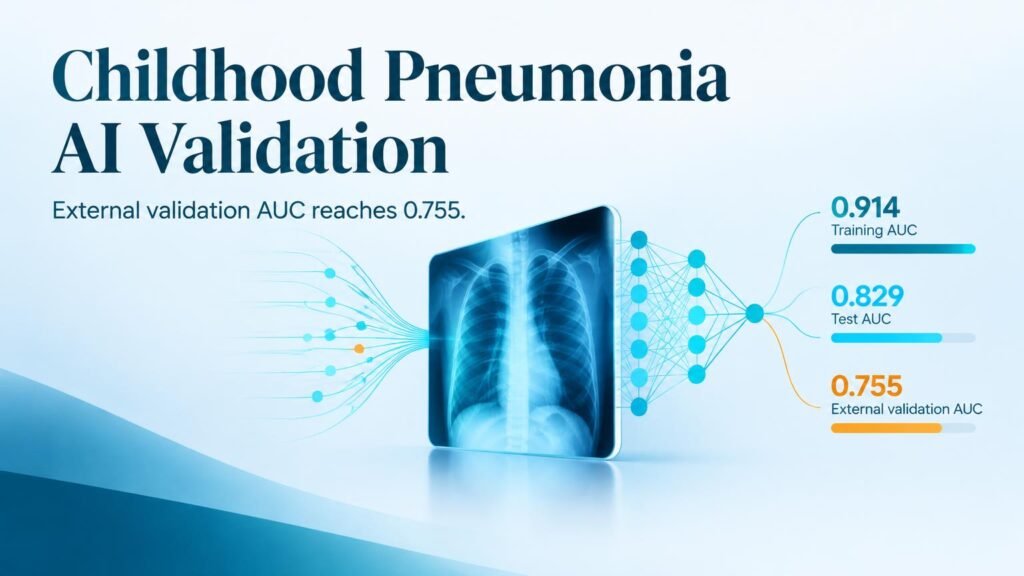
The neural network achieved a strong 0.914 AUC in internal training and maintained a 0.829 AUC in the internal test set. But when deployed on an independent external validation cohort of 640 patients from a separate hospital, performance fell to an AUC of 0.755. While decision curve analysis showed modest net benefit, the step-down in discrimination demonstrates how algorithms overfit to regional practice patterns or local lab baseline values.
This finding builds on previous work attempting to map secondary organ damage in pediatric infections. Researchers have previously constructed a differential diagnosis and organ damage model for severe MPP and evaluated risk factors through a multicenter clinical characteristic analysis. Earlier efforts also introduced a predictive nomogram for acute liver injury in pediatric pneumonia. Yet translating these statistical tools into real-world software remains tricky.
Why This Matters
A drop to 0.755 AUC means the model misses too many high-risk patients or triggers false alarms to be trusted blindly. The authors packaged their model into an interactive web application for point-of-care risk stratification. However, clinical teams should hesitate before embedding single-region web calculators into daily routines. Retrospective accuracy is not proof of clinical utility, and deploying an uncalibrated tool risks alert fatigue or delayed care for children whose lab profiles do not match the original training site.
Future iterations must train on broader multi-site data to ensure algorithmic stability before these calculators reach the bedside.
Read the original research in Scientific Reports.