
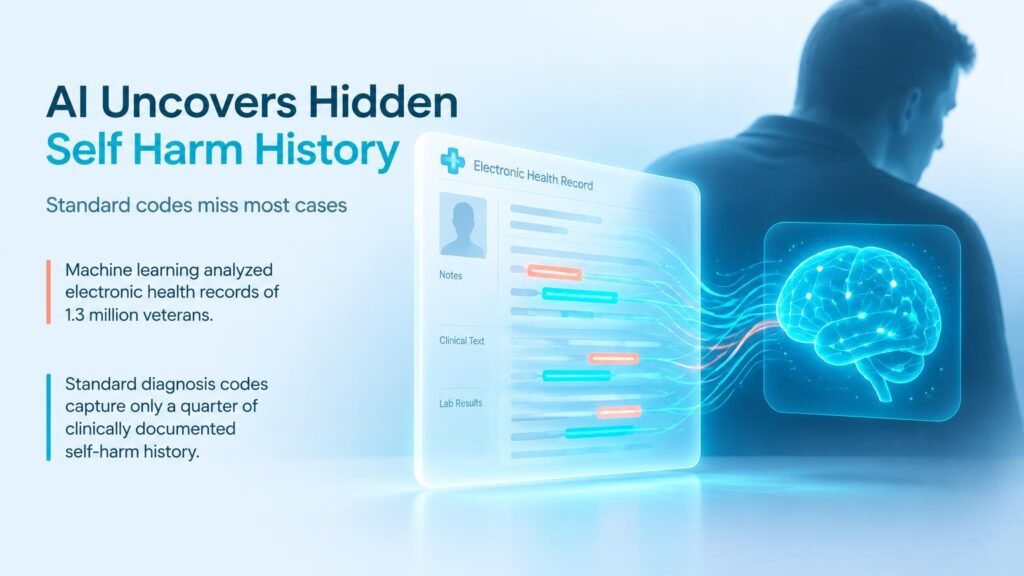
Standard medical billing codes miss three-quarters of documented self-harm histories among military veterans.
The Missing Data
Healthcare algorithms rely heavily on structured diagnostic codes to flag patients at risk. A new machine learning model analyzing records from 1.3 million veterans reveals those codes capture only 1.85% of self-harm history. Unstructured clinical notes, however, show the real prevalence is 10.46%.
Systemic Blind Spots
Relying solely on structured ICD codes leaves health systems blind to over 75% of documented self-harm events. Risk-prediction tools trained on billing data operate on heavily flawed baselines. When algorithms miss these critical signals, high-risk patients lose out on timely interventions.
Practical Hurdles
Extracting insights from free-text clinical notes requires natural language processing. Yet deploying these tools into daily workflows threatens to worsen clinician alert fatigue and trigger data privacy concerns. Until predictive systems parse unstructured text efficiently, automated suicide risk models will remain dangerously incomplete.