Hospitals are drowning in false sepsis alerts, but a new machine-learning model proves we can detect this killer faster by cleaning up our training data.
Why do hospital sepsis alerts fail? They cry wolf too often because the clinical data we train them on is messy and filled with administrative coding errors.
This disconnect is the real story. For years, developers believed that more patient history was the key to building better algorithms. This study challenges that assumption, proving that cleaner data, not longer observation, is what actually saves lives. If an algorithm can make an accurate call in hours rather than days, it changes how we design clinical workflows. It means we can intervene before systemic organ failure sets in, rather than playing catch-up.
The data noise problem
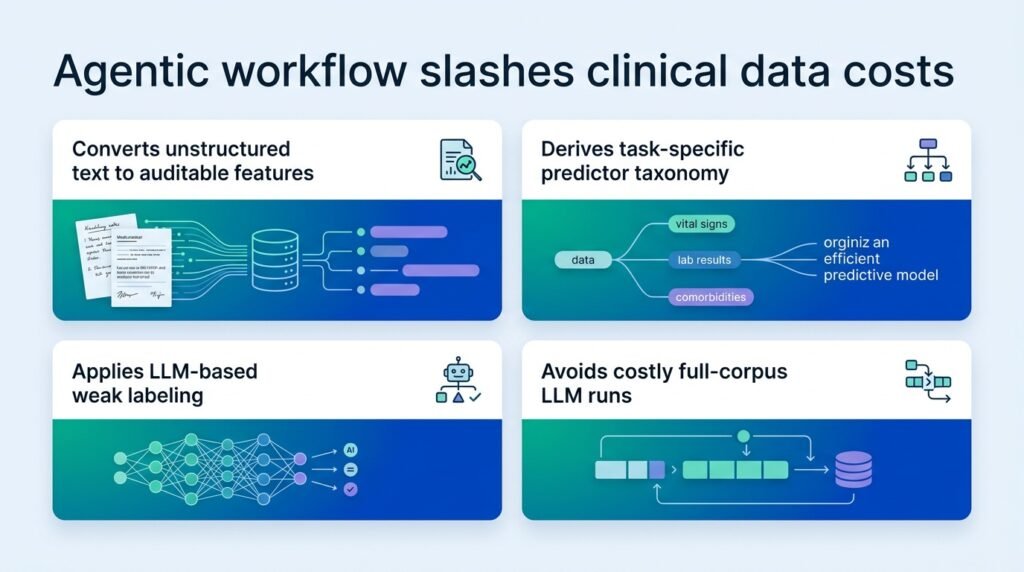
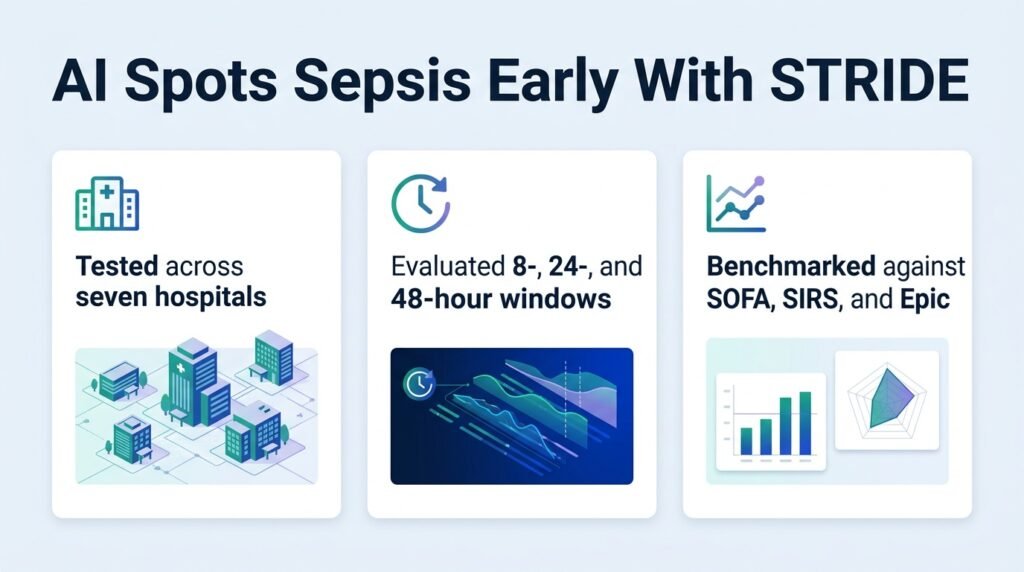
Sepsis is notoriously hard to track because hospital billing codes are highly inaccurate. To solve this, researchers built STRIDE, a machine-learning framework evaluated across 356,610 encounters in seven hospitals. Instead of accepting noisy billing codes as truth, they used a large language model to scan discharge summaries and refine the diagnostic labels. They then validated this approach against an independent, physician-adjudicated cohort to ensure the AI was learning from true clinical ground truth.
Speed beats deep history
Most sepsis models demand days of clinical history to make a reliable prediction. STRIDE compared 8-, 24-, and 48-hour observation windows to see how quickly the system could flag the condition.
The shortest window won. The 8-hour model achieved an AUC of 0.960 in derivation and 0.878 in physician-adjudicated validation, matching or outperforming the longer-window models.
The system also proved highly capable of separating true sepsis from lookalikes:
- It achieved 78.2% specificity at 80% sensitivity in validation.
- It outperformed traditional clinical tools like SOFA and the proprietary Epic sepsis model on discrimination.
- It retained strong discrimination even among patients who had systemic inflammatory response syndrome (SIRS) but did not actually have sepsis.
The clinical reality
This is not just a statistical victory. In a chaotic emergency department, false alarms cause severe alert fatigue, which leads clinicians to ignore critical warnings. By maintaining 78.2% specificity, this model cuts down on unnecessary alerts. It proves that we can run highly accurate surveillance without requiring extensive prior medical history, making it viable for patients who have just arrived at the hospital.
There are limitations to consider. The framework relies on discharge summaries to refine its training labels, which means its success depends heavily on the quality of clinical documentation. It remains a preprint and needs real-world clinical trials.
Still, the implications are profound. We do not need to wait days to build a patient profile. By using AI to clean up our historical data, we can build tools that make accurate decisions in hours.
Read the full study in medRxiv.