
Deploying AI to triage lung nodules expands clinic capacity and procedure volume, but it does not yet prove faster or better cancer detection.
Hospitals buying artificial intelligence often expect immediate diagnostic breakthroughs. A new real-world evaluation across three US health systems shows a different reality. The software acted primarily as an operational funnel, filling clinics and procedure suites without demonstrating a statistically significant improvement in cancer identification.
That distinction matters for health system leaders. While AI software can help clinicians capture missed incidental findings, administrative growth should not be confused with confirmed clinical efficacy.
More Patients and More Procedures
The study analyzed clinic activity over matched 12.5-month periods before and after launching a commercial AI triage tool. Across three US lung nodule clinics, new patient volume jumped sharply following deployment. The software effectively broadened the top of the clinical funnel, driving more patients toward specialist review.
This operational surge directly boosted downstream interventional care. Key throughput metrics included:
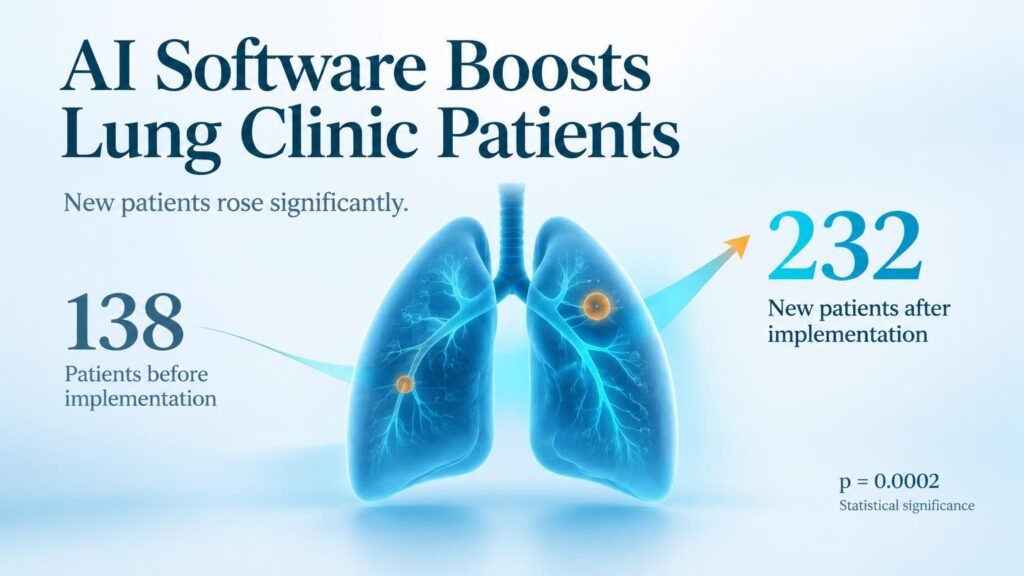
- New patients increased from 138 to 232 total, moving from 11.0 to 18.6 patients per month (p = 0.0002). Median monthly intake grew from 9 to 16 patients.
- Patients undergoing at least one invasive procedure rose from 4.9 to 8.0 per month (p = 0.0085).
- Median time to diagnosis remained flat at 58 days before versus 57 days after implementation (p = 0.26). However, the interquartile range narrowed from 125 days to 58 days.
- Monthly cancer diagnoses trended upward from 3.0 to 3.8 (p = 0.3242), while early-stage cancer finds shifted from 1.4 to 2.4 per month (p = 0.125).
These findings mirror broader research into imaging algorithms. Previous studies on AI software for lung nodule detection and broader reviews on risk stratification of pulmonary nodules show that automated tools excel at flagging small lesions that human readers overlook during routine care.
Volume vs Clinical Outcomes
The core tension lies in what the data failed to prove. The increases in total cancer cases and early-stage diagnoses were not statistically significant. Similarly, the software did not significantly shorten the median timeline from initial scan to diagnosis.
This reveals a crucial trade-off. The tool clearly boosted throughput and procedure rates, which drive hospital revenue. Yet without a significant shift in patient outcomes, health systems risk increasing invasive interventions without a guaranteed rise in true cancer catches.
The main limitation of this trial is its observational before-and-after design across just three sites. External operational changes, such as revised referral patterns, could account for part of the volume shift. Clinicians looking to adopt similar software should track diagnostic yield per procedure, ensuring that increased workload actually translates to early cancer intervention.
Source study published in PLoS ONE.