A patient’s fate is often hidden in the messy paragraphs of their medical charts rather than their official disease stage.
Why do two cancer patients with the exact same tumor stage end up with completely different survival outcomes? For decades, oncology has relied on the rigid TNM (Tumor, Node, Metastasis) staging system to predict patient survival. But TNM ignores the human context—the subtle notes about a patient’s physical frailty or minor symptoms that doctors scribble down during visits.
This disconnect is where standard prognostics fail. A new study shows that unstructured clinical notes contain the real signal, and AI can finally extract it. By turning casual clinical prose into hard data, this approach challenges the supremacy of structured medical registries.
Beyond the tumor stage
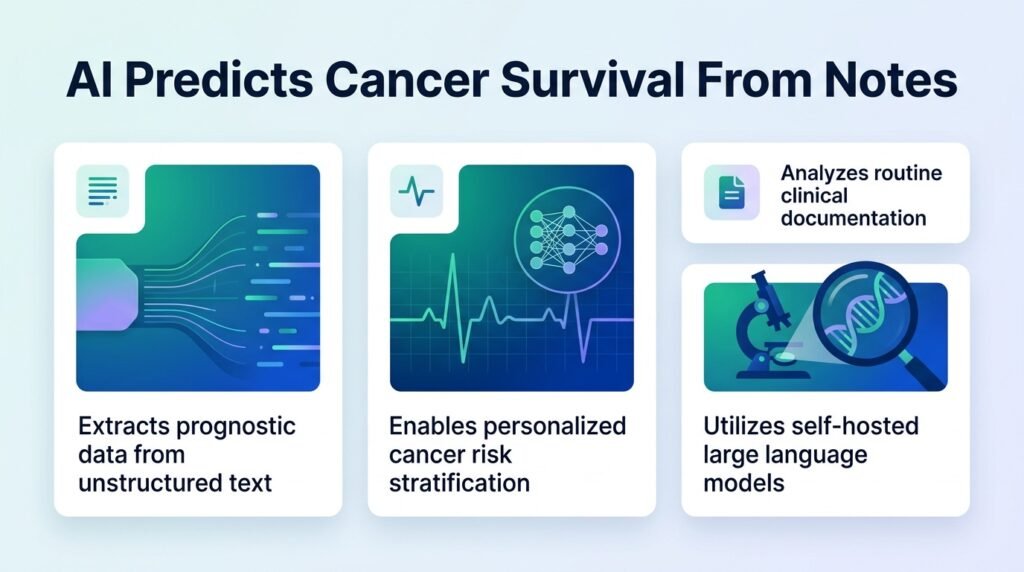
Researchers used self-hosted large language models to analyze unstructured medical notes from 2,708 non-small cell lung cancer (NSCLC) patients and 814 colon cancer patients. The AI worked in a zero-shot manner, meaning it required no prior task-specific training to identify key prognostic indicators. It successfully extracted comorbidities, metastatic sites, and qualitative descriptions of the patients’ physical conditions.
The AI did not just find keywords. It understood context, capturing how a patient actually felt and moved. This means the qualitative, subjective side of medicine—often dismissed as “soft” data—can now be quantified and scaled. When these text-derived features were combined with traditional staging, the predictive accuracy soared.
The numbers that matter
The study compared the AI-enhanced model against traditional TNM staging using the C-Index, where a higher score means better survival prediction.
- For NSCLC patients, the predictive accuracy jumped from 0.64 with TNM alone to 0.72 with the AI model.
- For colon cancer patients, the accuracy rose from 0.59 to 0.70.
- The AI-informed risk scores allowed researchers to reclassify 61.4% of NSCLC patients and 68.3% of colon cancer patients into more accurate risk categories.
The AI model also outperformed traditional text embedding methods. By grouping patients into four distinct risk tiers, the system proved that qualitative details, like a patient’s general physical condition, heavily influence how much a tumor stage actually matters to their survival.
The reality check
This approach has clear limitations. The data came from a single comprehensive cancer center, meaning the AI’s performance might degrade when faced with different drafting styles from other hospitals. Furthermore, relying on self-hosted LLMs requires significant local computing power, which is still a barrier for smaller clinics.
But the implication is clear. We must stop treating clinical notes as administrative waste. If unstructured text can reclassify over sixty percent of cancer patients, then ignoring this data is no longer just inefficient—it is a clinical oversight.
This analysis is based on research published in PLOS Digital Health.