
A new clinical validation study shows that AI software bridges the diagnostic gap between novice and expert dentists, but struggles to catch early-stage gum disease on its own.
Can software turn a rookie dentist into a seasoned expert overnight? For years, dental clinics have debated whether AI diagnostics actually improve patient care or just add digital noise to x-ray screens. The answer depends entirely on who is holding the drill.
This clinical trial reveals that AI acts as an equalizer rather than an enhancer. It does not make masters better, but it prevents beginners from making critical misses. This challenges the industry narrative that AI will elevate all medicine equally. Instead, its true value lies in setting a high safety floor for junior staff.
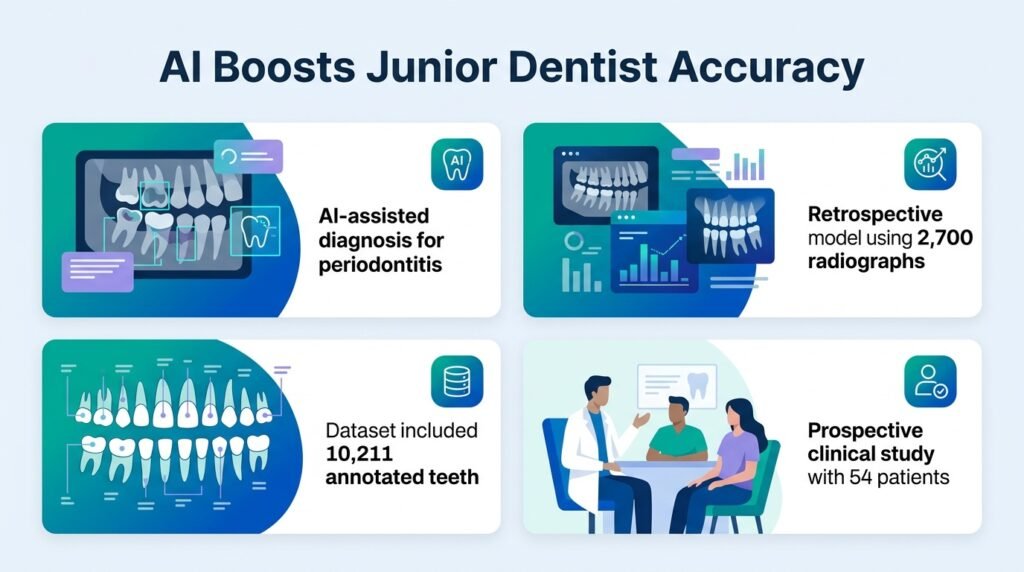
Researchers built their system using 2,700 periapical radiographs containing 10,211 annotated teeth. They tested the tool on a prospective cohort of 54 patients, pitting the AI-assisted workflows against human clinicians. For caries detection, the system relied on a ConvNeXt-Tiny model, while periodontitis staging used a multi-stage framework combining YOLO segmentation and ResNet-50 regression.
The diagnostic equalizer
The clinical split was stark. Junior dentists saw their diagnostic accuracy jump from 67.9% to 86.6% when using the AI. Meanwhile, the senior dentist remained virtually unchanged, scoring 94.0% alone and 94.1% with the software.
The underlying models showed mixed performance across different tasks:
- The caries model achieved an AUC of 0.8828 and an overall accuracy of 76.49%.
- Caries recall reached 88.24%, meaning the system rarely missed a cavity.
- Periodontitis staging accuracy was much lower at 61.3% with a macro-ROC-AUC of 75.4%.
- Stage III periodontitis recall was strong at 79.6%, but early-stage cases (Stages I and II) were frequently missed.
Why this matters
This performance gap in early-stage gum disease is a critical limitation. If junior dentists rely too heavily on the software, they will miss early bone loss, which is precisely when intervention is most effective. This finding aligns with earlier research on artificial intelligence for caries and periapical periodontitis detection, which highlights the difficulty of automated tools in identifying subtle tissue changes.
Rather than replacing human eyes, the tool acts as a safety net. It protects patients of less-experienced practitioners from diagnostic errors. However, as discussed in BDJ Student, clinicians must remain cautious about over-reliance on automated tools for early detection.
Ultimately, this tool is a proof-of-concept that requires human confirmation. It excels at spotting obvious cavities and advanced bone loss but falters on subtle, early-stage disease.
Read the full study in BMC Medical Informatics and Decision Making.