By ditching hand-curated clinical profiles for raw administrative codes, researchers built an AI that predicts long-term mortality better than traditional medical indices.
Can administrative billing codes predict whether you will be alive in fifteen years? For decades, medicine has relied on curated clinical indices like the Charlson Comorbidity Index to estimate mortality risk. This new study suggests those hand-crafted tools are obsolete. By feeding raw billing data into simple machine learning models, researchers outperformed classic clinical benchmarks without needing a doctor to define what matters.
The real story here is the shift in how we value clinical data. We often assume that predicting long-term survival requires deep, structured clinical narratives. This trial suggests the “noise” of daily outpatient billing—every routine checkup code and prescription refill—holds a clearer signal of long-term survival than structured disease profiles.
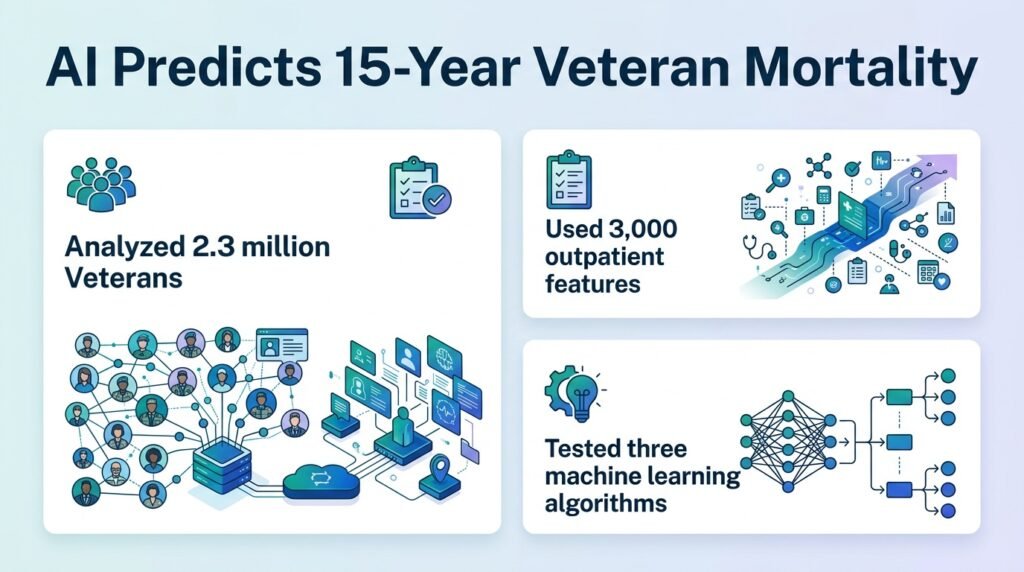
The study analyzed outpatient records from 2.3 million Veterans in the largest integrated U.S. healthcare system. Instead of grouping patients by pre-defined diseases, the team pulled the 1,000 most common outpatient codes across three categories: ICD-9 diagnoses, Current Procedural Terminology (CPT) codes, and prescription drugs (Rx). They trained three algorithms—logistic regression with lasso, random forest, and a 3-layered feed-forward neural network—to predict 15-year all-cause mortality. This massive scale builds on previous efforts to utilize the Department of Veterans Affairs’ vast data infrastructure, such as the COVID-19 Insights Partnership, which demonstrated the power of combining VA records with high-performance computing.
The performance gap
The machine learning models consistently outpaced traditional clinical baselines. While the Charlson Comorbidity Index, Elixhauser, and VACS indices scored C-statistics between 0.739 and 0.804, the raw-data algorithms achieved C-statistics of 0.82 to 0.84. This performance edge remained steady across diverse subgroups, including veterans under 65, those over 65, Black veterans, and Hispanic veterans.
- Model accuracy reached C-statistics of 0.82 to 0.84 compared to a maximum of 0.804 for traditional indices.
- Cardiovascular diseases and mental health treatments emerged as the most powerful long-term mortality indicators.
- Unsupervised clustering techniques like PCA and K-means successfully mapped complex interactions between diagnoses and treatments.
Why this matters
The real value of this research is not just a higher accuracy score. It is the realization that we do not need complex, hand-curated clinical phenotypes to stratify patient risk. By letting the algorithms find patterns in raw outpatient codes, the system bypassed human bias about which diseases “matter” most. It turns out that the administrative trail a patient leaves behind is highly predictive on its own.
However, we must look at the limitations. The study relies on VA data, a population that is heavily male and has distinct health trajectories. Specifically, the high predictive weight of mental health codes reflects a cohort with unique psychological burdens, a challenge also noted in studies on mental-health crisis prediction in U.S. Veterans. Applying this framework to civilian populations might yield different dominant predictors.
The clinical reality
Relying on billing codes also introduces administrative noise. Doctors code for reimbursement, not just clinical reality, which can skew the data. Even so, the sheer predictive power of these raw codes suggests that the future of risk stratification lies in the administrative exhaust of healthcare, not in tedious manual charting.
Read the full study in Scientific Reports.