A new machine learning model spots the slow march toward gastric cancer using basic lab work, but its struggle with middle-stage disease shows where clinical AI still needs to mature.
Can we spot stomach cancer before it actually becomes cancer, without relying on expensive, invasive endoscopies?
Doctors have long struggled to map the slow, multi-step transition from H. pylori infection to gastric cancer. This study challenges the idea that we need complex genomic sequencing or invasive biopsies to track this progression. By using basic blood panels, researchers proved that systemic signals of inflammation are already visible in routine labs.
Yet the model’s struggle to distinguish between adjacent middle stages reveals a deeper truth. Biological transitions are messy, and clinical AI cannot easily draw hard lines through a continuous disease spectrum.
Mapping the cancer cascade
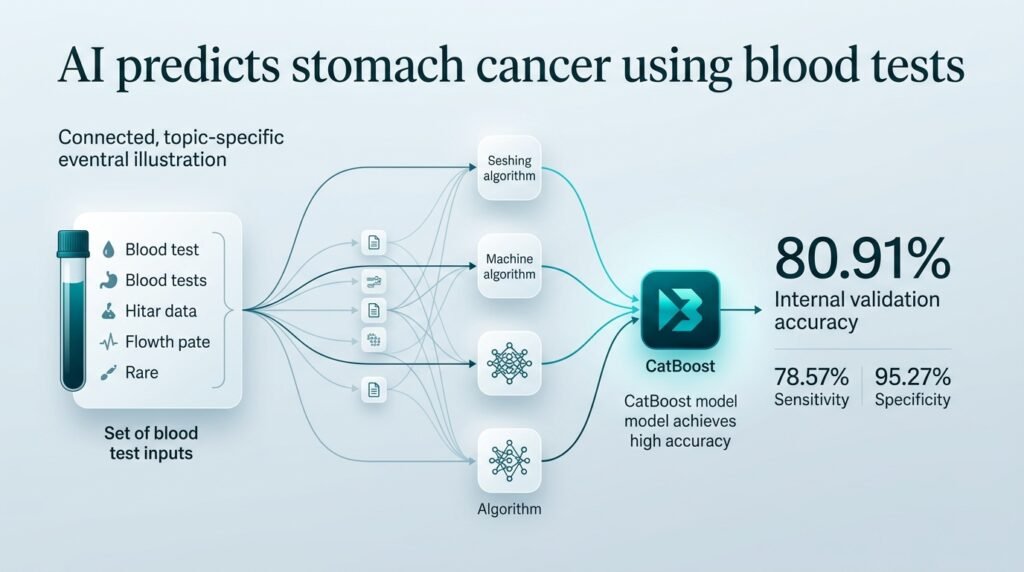
Researchers built and validated their model using data from 1,784 patients across two clinical centers, after filtering out incomplete records from an initial pool of 2,180. The cohort spanned healthy controls, patients with nonatrophic gastritis, atrophic gastritis, intestinal metaplasia, and full-blown gastric cancer. Out of six machine learning algorithms tested, a CatBoost model using just 27 routine features performed the best. These features included basic markers like monocyte count, albumin/globulin ratio, basophil percentage, platelet distribution width, total bilirubin, and creatinine.
Instead of looking for a single magic biomarker, the algorithm analyzes how these common metabolic and inflammatory signals shift in tandem.
How the model performed
- 80.91% internal validation accuracy, with a high specificity of 95.27%.
- 79.96% accuracy and an AUC of 0.94 in the external Guangdong Provincial People’s Hospital cohort.
- 83.37% accuracy and an AUC of 0.97 in the Shengli Oilfield Central Hospital cohort.
- High reliability in identifying healthy patients and advanced cancer, though adjacent intermediate stages often blurred together.
The diagnostic reality check
This blurring of middle stages is not just a software glitch. It reflects a known clinical headache. As outlined in the AGA Technical Review on Gastric Intestinal Metaplasia, tracking the natural history of these precancerous lesions is notoriously difficult because tissue changes do not happen overnight.
Whether intestinal metaplasia is a real culprit or innocent bystander remains a hot debate in gastroenterology. This AI confirms that the biology of these middle stages is a gradient, not a set of neat boxes.
For clinicians, this means the tool is highly effective at the extremes. It can confidently rule out healthy patients and flag high-risk cases. However, doctors should not rely on it to micro-manage the exact step-by-step transition of mid-stage lesions.
The real value of this tool is its accessibility. Because it runs on routine lab work, it could act as an automated triage system in low-resource clinics. It flags who needs an urgent endoscopy without requiring specialized, expensive diagnostic infrastructure.
This research was published in the Journal of Medical Internet Research.