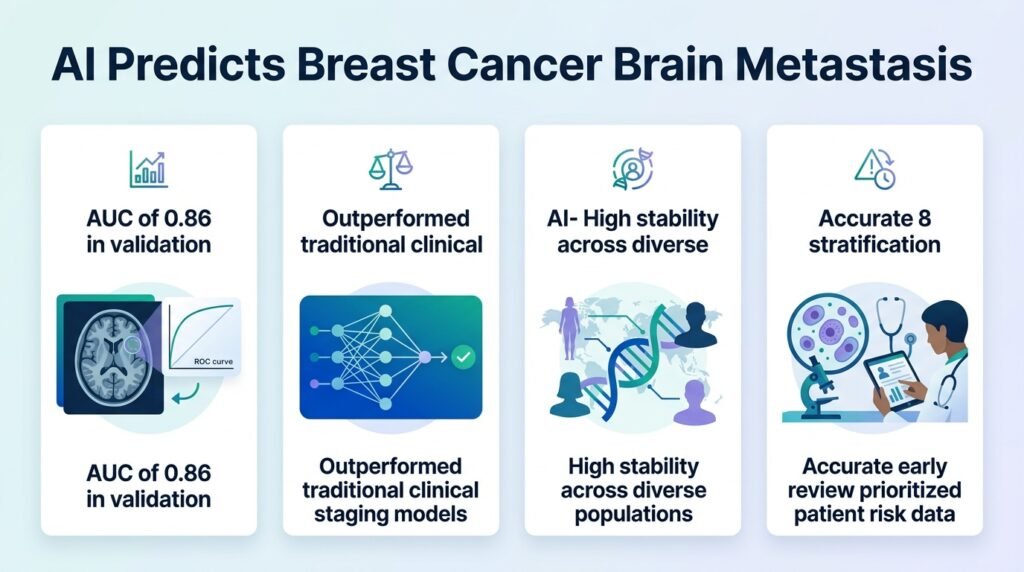
A new multi-center model uses basic clinical data to flag brain metastasis before symptoms appear, challenging the need for expensive, complex biomarkers.
When breast cancer spreads to the brain, the prognosis drops precipitously. Yet clinicians lack a reliable way to screen patients before neurological symptoms emerge. This forces oncology into a reactive posture, treating brain lesions only after they have already caused damage.
This new study challenges the assumption that we need complex genetic sequencing or expensive imaging to predict metastasis. By relying on basic, readily available clinical variables, the researchers prove that simple data, when structured correctly, can outperform complex diagnostic panels. It shifts the focus from high-tech biomarkers to maximizing the utility of routine clinical data. This mirrors similar efforts to simplify oncology forecasting, such as recent work on interpretable models for metastatic breast cancer.
Simple inputs, high accuracy
The researchers analyzed a massive retrospective cohort of 186,351 primary breast cancer patients drawn from the SEER program, the National Cancer Database, and a multi-center Chinese cohort. Within this population, 2,982 patients (or 1.6%) developed brain metastasis. These patients typically presented with more advanced disease characteristics and aggressive treatment patterns at baseline.
Instead of using hundreds of variables, the final LASSO-regularized Logistic Regression model stripped the noise down to just five key predictors: AJCC N stage, M stage, T stage, age, and surgery status. This streamlined approach achieved remarkable predictive power.
- An AUC of 0.907 (95% CI: 0.857–0.958) in the validation set, demonstrating strong discrimination.
- High interpretability verified by SHAP analysis, showing exactly how each factor weights individual risk.
- A significant survival difference (p < 0.001) confirming the poor prognosis of those flagged.
This success in brain metastasis prediction aligns with parallel research, such as a recent model designed to predict lung metastasis in breast cancer, which also relied on accessible clinical data.
The real-world hurdle
The model’s high AUC is impressive, but retrospective validation is not a clinical trial. The 1.6% event rate means the model is searching for a needle in a haystack. In clinical practice, this low prevalence can lead to false positives. If clinicians over-screen based on these risk scores, they risk driving up healthcare costs and patient anxiety without clear evidence of improved survival outcomes.
We must also consider the geographic diversity of the training data. While combining North American and Chinese cohorts helps generalize the findings, clinical practices and screening protocols vary wildly between these regions. A model trained on these mixed populations might still require local calibration before safe deployment.
Furthermore, while the model is deployed as a web tool, its utility depends on active clinical adoption. Without integration into existing electronic health records, it remains an extra step in an already crowded workflow. Clinicians need tools that fit into their daily routine, not another tab open on their browser.
Read the full study in the Journal of Translational Medicine.