
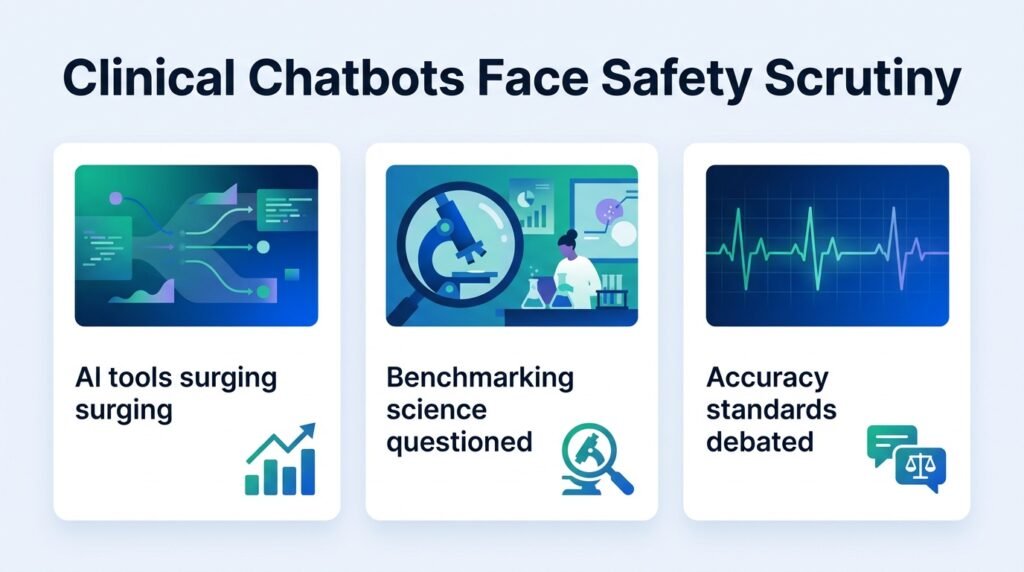
Passing a multiple-choice medical exam does not make an AI safe to treat real patients.
Medical chatbots are flooding clinical workflows, yet the tests used to validate them are fundamentally broken. While developers boast about high scores on standardized licensing exams, these benchmarks fail to measure real-world clinical reasoning. We are grading AI on its ability to memorize, not its ability to heal.
The Testing Illusion
The gap between exam scores and clinical reality is widening. Recent evaluations show that while large language models ace multiple-choice questions, they frequently hallucinate or offer inaccurate advice when faced with actual patients. The core issue is data contamination. The AI has often already memorized the test questions during its training phase, making exam scores a poor proxy for actual competence.
This is not just a technical glitch. It is a safety hazard.
A Parallel System
Despite these flaws, public adoption is moving faster than regulatory oversight. Up to 15% of patients now consult chatbots for medical advice. Some even trust them as much as human doctors. This shift is quietly building an unregulated, parallel healthcare system. When a chatbot provides flawed advice that leads to patient harm, the legal system has no clear framework for liability.
This leaves doctors in a difficult position. They are pressured to adopt tools that look highly capable on paper but remain unpredictable in practice. Hospitals and developers are racing ahead without a map. Until benchmarking measures actual patient safety rather than memorized data, relying on these tools remains a high-stakes gamble.