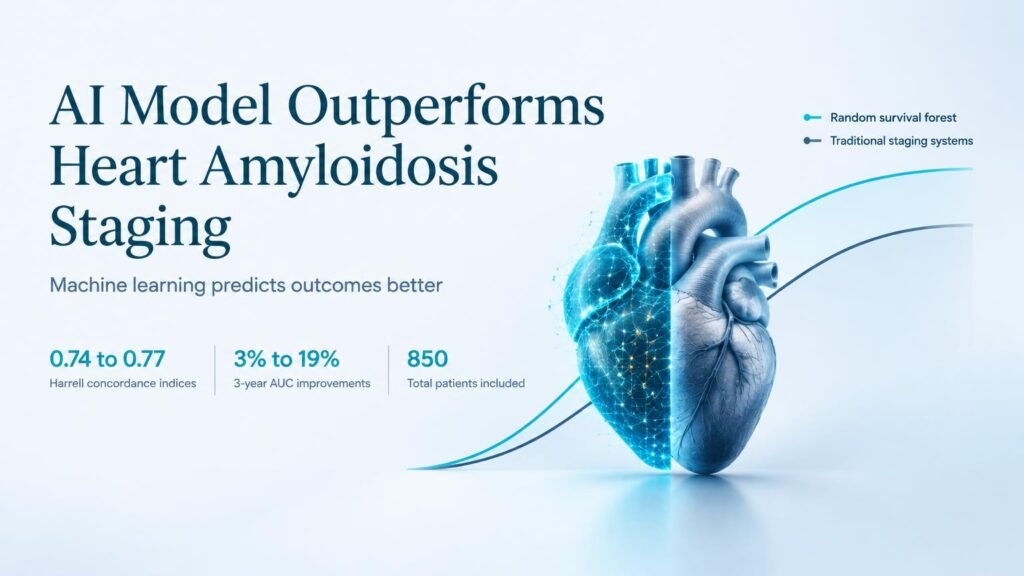
A machine learning model predicts death and heart failure hospitalizations in cardiac amyloidosis better than standard clinical staging tools.
Traditional clinical staging for transthyretin cardiac amyloidosis often fails to give clinicians a precise picture of patient risk. Existing tools like the Mayo Clinic or National Amyloidosis Centre systems were built before modern disease-modifying therapies reshaped patient survival. That mismatch leaves doctors guessing when triaging care for complex cardiac patients.
A new study published in JAMA Cardiology presents a machine learning alternative designed to fix that gap. Researchers developed a time-to-event random survival forest model using clinical, demographic, laboratory, medication, and echocardiographic data. They trained and tested the model on 850 patients across Swiss and Austrian registry centers between 2014 and 2025.
The patient pool reflected typical real-world disease demographics. The cohort had a median age of 79 years and was 88.2% male. Data was analyzed across three main cohorts: Bern, Switzerland (352 patients), other combined Swiss centers (260 patients), and Vienna, Austria (238 patients).
To test generalizability, the team used internal-external cross-validation, holding out each center iteratively. The primary outcome tracked a combined risk of all-cause mortality and heart failure hospitalization over time.
Superior risk prediction accuracy
The algorithm consistently beat traditional risk scores across all validation centers. Discrimination remained strong even among sub-groups receiving active disease-modifying treatments.
- Harrell concordance indices hit 0.74 in Bern, 0.77 in the rest of Switzerland, and 0.72 in Vienna.
- 3-year AUC metrics were 0.73 for Bern, 0.80 for other Swiss centers, and 0.75 for Vienna.
- C-index gains improved by 2% to 10% over Mayo and National Amyloidosis Centre systems.
- 3-year AUC improvements jumped by 3% to 19% compared to traditional staging.
The real clinical advantage lies in how the model handles complex health variables simultaneously. Rather than relying on rigid blood marker cutoffs, the model pulls risk signals out of subtle interactions between imaging and laboratory trends.
That shift turns static baseline testing into a continuous risk assessment.
Limitations and practical implementation
Better risk scores do not guarantee better clinical choices. The study relies entirely on European tertiary registries, which were nearly 90% male, limiting direct application to women and broader global populations.
Higher concordance scores prove prediction accuracy, but they do not prove that altering therapy based on this model saves lives. Until prospective trials test whether algorithm-guided care actually drops hospitalization rates, standard staging systems will stay in place.
Read the complete study in JAMA Cardiology.