A decentralized training strategy lets hospitals repurpose adult radiology AI for vulnerable newborns without sharing patient data.
Fewer than one in five commercial radiology AI tools are cleared for pediatric use. Most models are built on adult scans and perform poorly on newborns, whose small anatomical scale leaves no room for error. Hospitals rarely have the massive, curated pediatric datasets needed to train new models from scratch.
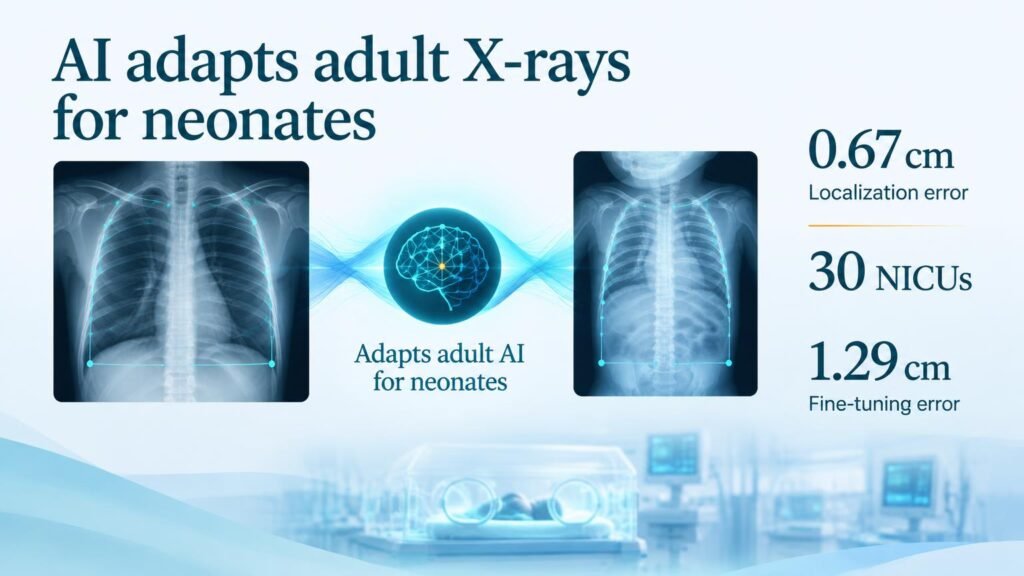
An international study published in Nature Biomedical Engineering tested continual learning to fix this bottleneck. Researchers adapted an adult endotracheal tube assessment model across 30 neonatal intensive care units in 20 countries. Each hospital contributed just 50 radiographs for sequential retraining without sharing patient images centrally.
Better accuracy without shared data
The privacy-preserving approach dramatically cut positioning errors across diverse hospital settings. Updating the algorithm sequentially proved far more effective than training isolated models at individual sites.
Key results across the international cohort include:
- Anatomical landmark error dropped to 0.67 cm with continual learning, compared to 1.29 cm for site-specific fine-tuning and 4.30 cm for unadapted adult models.
- Continual learning achieved lower localization errors at 29 of 30 sites.
- Detection of dangerous deep intubations improved at 27 of 30 sites.
Solving the pediatric data bottleneck
That leap in accuracy changes the practical risk for tiny patients. An endotracheal tube misplaced by one centimeter in an adult is a minor deviation, but in a neonate, it can cause lung collapse or fatal airway damage.
This retrospective study does not prove the tool reduces clinical complications in real-time practice. Single-site historical image sets are not a substitute for prospective clinical trials. Yet the findings prove that health systems do not need to pool sensitive patient data to build accurate pediatric tools. Health systems can safely upgrade existing adult software using small batches of local data.
Read the full study in Nature Biomedical Engineering.