
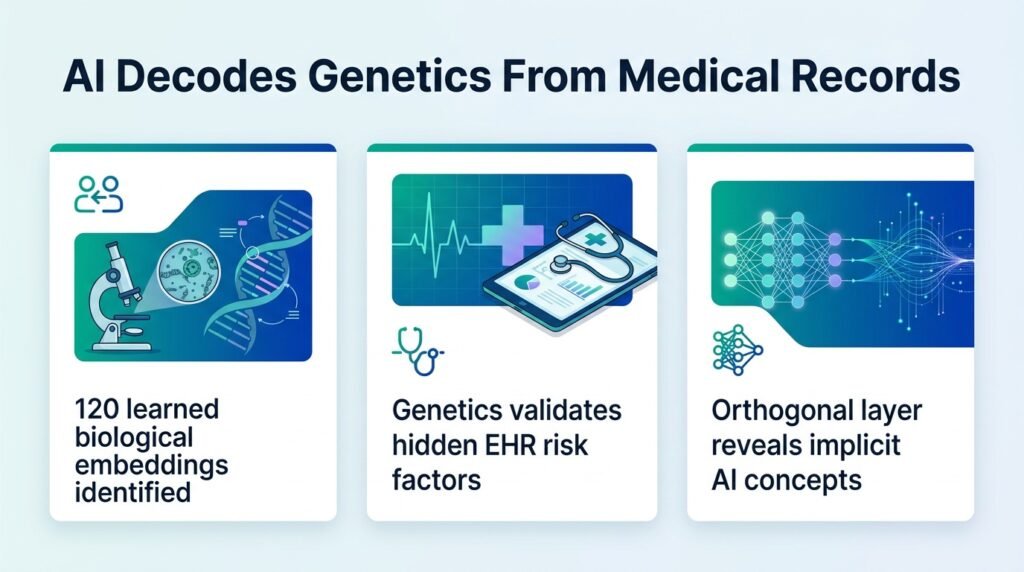
An AI trained only on medical records managed to map the genetic drivers of human disease.
Can an AI understand human biology without ever looking at a strand of DNA? Researchers expected the Delphi-2M model to merely organize patient charts. Instead, a new genetic analysis reveals the system mapped deep biological pathways entirely on its own.
This disconnect challenges how we view clinical AI. For years, skeptics dismissed medical language models as mere text-repackagers that mimic human charting biases. This study suggests they are actually learning implicit biology, which changes how we design drug discovery tools.
Researchers tested this by running the Delphi-2M transformer model on data from >500,000 UK Biobank participants. They analyzed the model’s 120 internal data representations, known as embeddings. The genetic search uncovered 434 genome-wide-significant signals across 151 independent genetic locations and 98 different embeddings.
Hidden biology revealed
The AI did not just find random noise. It showed a >50-fold enrichment for genetic variants linked to body-mass index, asthma, and blood lipids. Remarkably, these genetic signals pointed directly to the biological targets of almost every approved drug for asthma and high cholesterol.
It even flagged 12 drug targets that traditional genetic studies of single disease codes completely missed.
The biological ceiling
Yet, the model has a clear blind spot. While it predicted disease risks well, its internal embeddings were poor at explaining the actual biological variation in complex, multi-system risk factors. This reveals a hard ceiling for models trained purely on text.
This limitation is the real story for developers. It proves that simply feeding more text into larger models will not make them smarter clinical tools. To get meaningful predictive improvements for most common diseases, the AI still required the addition of specific diagnostic or organ-derived biomarkers.
This means medical records alone cannot solve personalized medicine. The real value of genetics here is not as a separate test, but as a training guide to keep clinical AI grounded in physical reality.
- Mapped 434 genetic signals across 151 independent loci.
- Identified 12 drug targets missed by standard genetic analyses.
- Showed over 50-fold genetic enrichment for asthma, BMI, and lipids.
Read the full preprint in medRxiv.