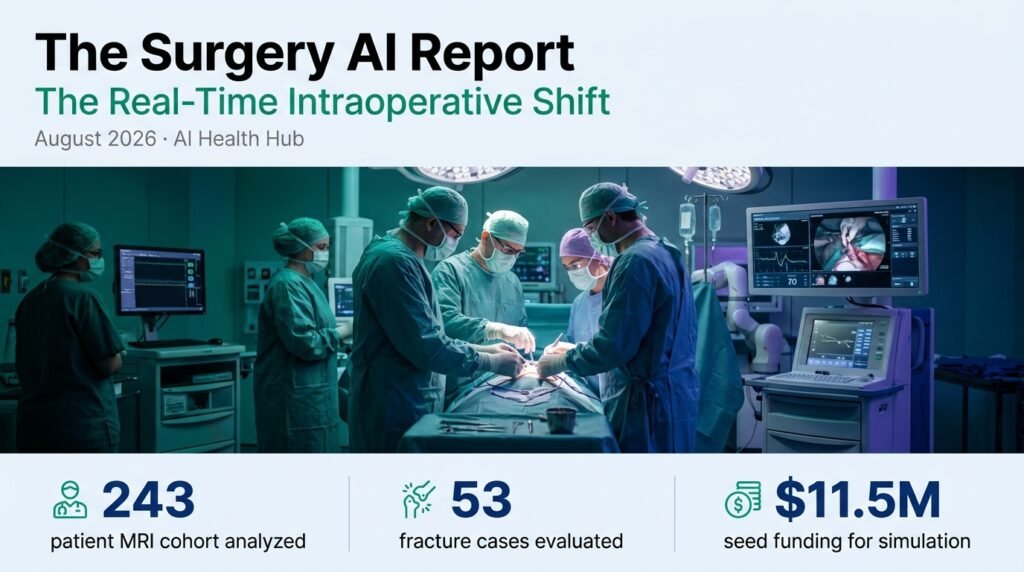
The surgical suite is undergoing a structural transition. For years, artificial intelligence in surgery was confined to pre-operative risk calculators and retrospective administrative tools. This month’s developments demonstrate that the field is rapidly moving toward real-time, intraoperative computer vision and hardware-integrated robotic platforms that actively assist clinicians during active procedures.
This shift is driven by a convergence of regulatory milestones for major robotic systems and clinical validation of real-time tracking algorithms. As computer vision models mature, they are transitioning from passive observers to active, closed-loop guides. Clinicians and product teams must now evaluate how these tools integrate into existing workflows without introducing cognitive overload or software latency.
Notable papers
• Artificial intelligence-supported segmentation of cardiac anatomy in open-heart surgery videos (https://doi.org/10.1007/s11701-026-03775-x)
This study developed a human-in-the-loop segmentation and tracking model to identify anatomical structures in congenital cardiac surgery videos, overcoming challenges of dynamic tissue motion and occlusion.
Brand take: Genuinely useful clinically, as real-time anatomical segmentation is the foundational software layer required for future autonomous robotic assistance.
• A two-stage deep learning model for predicting rotator cuff tear reparability from preoperative MRI (https://doi.org/10.1038/s41598-026-65820-x)
Researchers analyzed preoperative shoulder MRI scans of 243 patients to predict tear reparability using Patte and Goutallier classifications.
Brand take: Underrated, because objective preoperative classification reduces intraoperative surprises and improves patient consent accuracy.
• Integrating Artificial Intelligence in Orthopedic Decision-Making: A Comparative Analysis of Distal Radius Fracture Management (https://doi.org/10.5152/cjm.2026.25061)
This retrospective study of 53 patients evaluated the alignment between AI-generated and clinician-based treatment recommendations for distal radius fractures.
Brand take: Overhyped, as simple decision-alignment studies often fail to account for patient-specific lifestyle factors that dictate surgical versus conservative management.
• Can ChatGPT pass the polish national medical specialization examination in orthopedics and traumatology? (https://doi.org/10.1007/s00402-026-06435-9)
This paper evaluated the performance of large language models on specialized postgraduate orthopedic board examinations.
Brand take: Overhyped, as passing written multiple-choice exams does not translate to spatial reasoning or technical competency in the operating room.
• AI navigates brain surgery in first human trial (https://yesilscience.com/ai-navigates-brain-surgery-in-first-human-trial/)
A clinical trial demonstrated that real-time computer vision can guide neurosurgeons through high-stakes brain procedures, though early software bugs occurred.
Brand take: Genuinely useful clinically, despite the early bugs, because real-time navigation solves the critical issue of brain shift during open craniotomies.
• AI Predicts Heart Surgery ICU Overstay But Stumbles (https://yesilscience.com/ai-predicts-heart-surgery-icu-overstay-but-stumbles/)
A machine learning model designed to predict extended ICU stays after bypass surgery showed a significant drop in performance during external validation.
Brand take: Underrated, as highlighting these generalization failures is critical to preventing unsafe clinical deployments of brittle models.
Products, deals & funding
• Inner Logic’s $11.5M Seed Funding
Baltimore-based startup Inner Logic secured $11.5 million in seed funding to build a software foundation for autonomous surgery, allowing medical device companies to validate intelligent surgical systems in virtual environments.
Brand take: Genuinely useful clinically, as high-fidelity virtual validation is the only scalable way to test edge cases in robotic surgery without risking patient safety.
• Vexev’s $6M Funding for VxWave
Australian medical robotics company Vexev raised $6 million to accelerate US commercialization and FDA clearance of VxWave, its AI-powered robotic tomographic ultrasound platform.
Brand take: Underrated, because automating vascular ultrasound imaging removes significant operator variability in longitudinal patient tracking.
• Medtronic’s Touch Surgery™ Aide Launch
Medtronic launched Touch Surgery™ Aide, an AI-native surgical computing platform powered by NVIDIA infrastructure that runs real-time AI applications during robotic procedures.
Brand take: Genuinely useful clinically, as it provides the computing infrastructure necessary to run low-latency computer vision models directly in the operating room.
Regulatory & clinical adoption
The regulatory landscape saw major milestones this month, particularly in soft tissue and urological robotics. Johnson & Johnson received FDA De Novo authorization for its OTTAVA™ Robotic Surgical System, a table-integrated soft tissue robotic platform cleared for multiple general surgery procedures. This represents a direct challenge to established robotic platforms, emphasizing integrated, space-saving hardware designs. Concurrently, Korean medical robotics company Roen Surgical secured FDA clearance for Zamenix, its AI-assisted kidney stone surgery robot, signaling a push toward specialized, single-indication robotic systems.
Brand take on regulatory shifts: Genuinely useful clinically, as increased competition in the robotic space will drive down hardware costs and accelerate the adoption of intelligent software add-ons.
Trends & what to watch
The clear trend over the next 1-3 months is the transition from standalone software models to hardware-integrated AI. Platforms like Medtronic’s Touch Surgery Aide and J&J’s OTTAVA demonstrate that the future of surgical AI is physical. Software startups that do not integrate directly into the robotic console or the intraoperative video feed will find themselves locked out of the clinical workflow.
Furthermore, the industry is beginning to address the validation bottleneck. The $11.5 million seed round for Inner Logic highlights a growing realization: we cannot train autonomous surgical robots solely on real-world clinical data due to safety and liability constraints. Virtual simulation environments that can accurately model tissue physics and robotic kinematics will become essential infrastructure for clinical AI product teams.
Bottom line
Surgical AI is moving out of the pre-operative planning office and directly into the active surgical field through real-time computer vision and hardware-integrated robotics.