Yusuf Yesil, MD, MIS
Even when transferring genetically normal euploid embryos, in vitro fertilization fails roughly 40% of the time on the first attempt. Clinicians frequently attribute these losses to poor implantation timing, yet adjusting transfer schedules often leaves patients without answers or viable pregnancies.
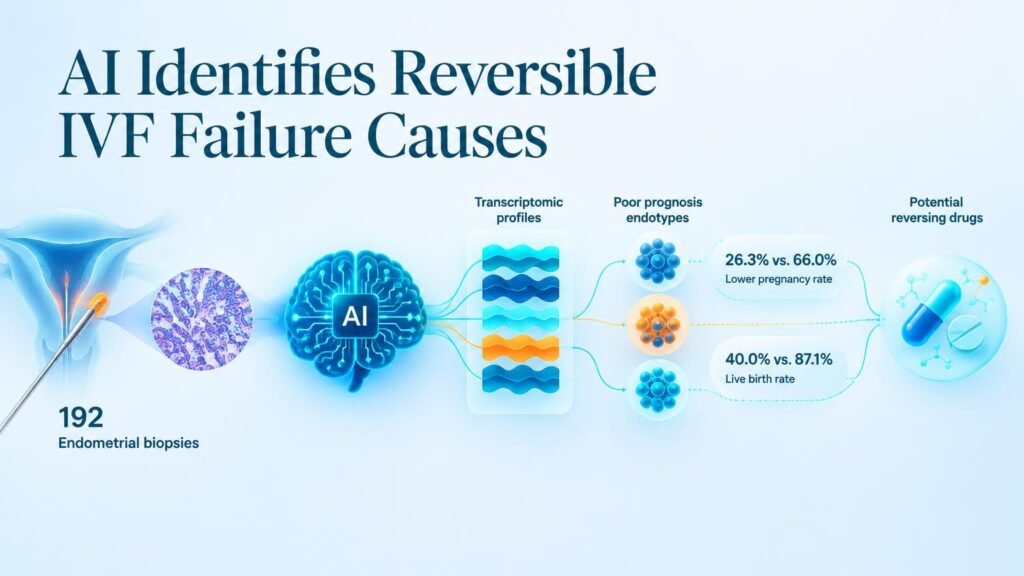
A multicenter prospective study published in Reproductive Biology and Endocrinology shows that the true culprit is often a structural, non-timing molecular dysfunction within the endometrium. By applying machine learning and systems pharmacology to 192 mid-secretory endometrial biopsies, researchers mapped precise biological drivers of repeated pregnancy loss and identified existing pharmaceuticals capable of reversing them.
Mapping hidden IVF failures
The analytical pipeline categorized patients into distinct prognosis endotypes based on transcriptomic profiles and reproductive outcomes. The poor-prognosis cohort (n = 43) exhibited severe endometrial dysfunction compared to the good-prognosis group.
Machine learning further separated this poor-prognosis group into two distinct molecular subendotypes, both marked by abnormal decidualization, with one subendotype specifically showing heavy immune dysregulation.
- Pregnancy rate: 26.3% in poor prognosis versus 66.0% in good prognosis (p = 1.99 × 10⁻⁵).
- Live birth rate: 40.0% in poor prognosis versus 87.1% in good prognosis (p = 0.0013).
- Biochemical miscarriage rate: 30.3% overall versus 7.2% (p = 0.0372), spiking to 66.7% in the biochemical subendotype (n = 16, p = 0.0022).
- Clinical miscarriage rate: 42.9% overall versus 6.2% (p = 0.0159), climbing to 50% in the clinical miscarriage subendotype (n = 27, p = 0.0001).
From transcriptomics to targeted drugs
Identifying transcriptomic defects matters only if clinicians can correct them. Using systems pharmacology, the team prioritized five candidate drugs to reverse these gene signatures: genistein, pioglitazone, alprostadil, flunisolide, and tenoxicam.
In vitro testing on human endometrial stromal cell lines confirmed these predictions. Genistein and pioglitazone successfully restored decidualization markers, while alprostadil, flunisolide, and tenoxicam suppressed elevated biomarkers of immune response.
That shifts the clinical mindset from passive embryo selection to active endometrial rescue.
What must happen next
These results challenge the long-standing assumption that idiopathic IVF failure is simply an unfixable mystery. However, cell line validations are not clinical cures. In vitro functional tests cannot replace prospective human trials, and these drugs must be tested in clinical transfer cohorts before practice guidelines change.
If validated in patients, this approach gives reproductive endocrinologists a actionable way to treat specific endometrial biological failures rather than burning through precious embryos on repeated failed transfers.
Read the full study in Reproductive Biology and Endocrinology.