 Yusuf Yesil, MD, MIS
Sepsis treatment fails because doctors treat the condition as a single immune storm rather than a cellular metabolic breakdown. By focusing on mitochondrial dysfunction, researchers built an algorithm that spots high-risk patients before multi-organ failure sets in.
That shift from broad inflammation to cellular energy failure is the real story.
Instead of relying on broad clinical symptoms, this tool pinpoints specific molecular breakdowns in real time. It challenges the traditional approach of treating all septic patients with identical immune-modulating protocols.
Mapping the metabolic breakdown
Researchers pulled transcriptomic data across 1,256 samples from five distinct cohorts (GSE65682, GSE95233, GSE54514, GSE26440, and GSE26378). They isolated 438 differentially expressed genes, revealing upregulated oxidative phosphorylation alongside suppressed T cell receptor signaling. Single-cell RNA sequencing across 59,731 cells traced this damage directly to monocytes and dendritic cells.
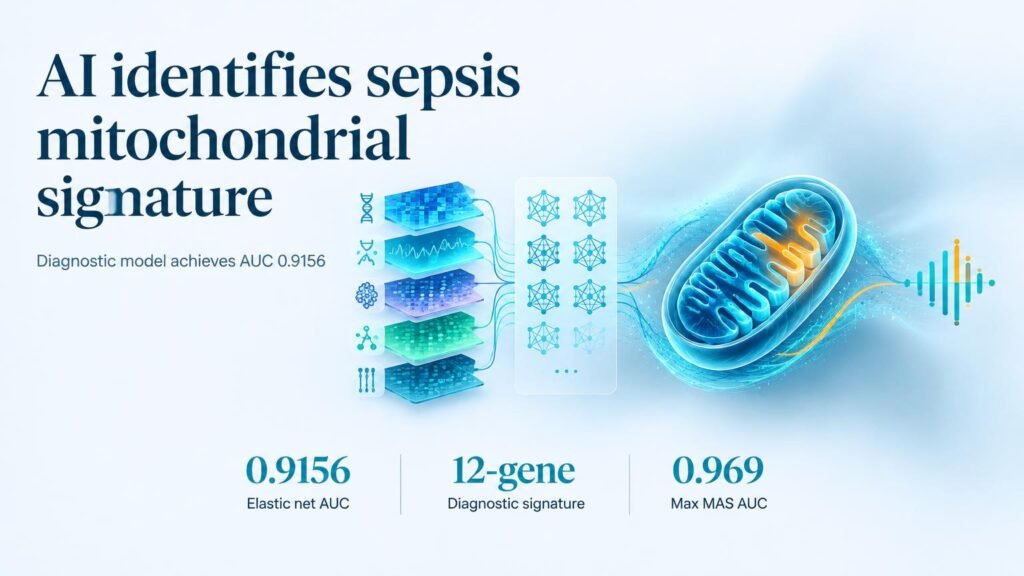
The team evaluated ten machine learning algorithms to map these metabolic shifts. Elastic net emerged as the top performer, delivering a diagnostic ROC AUC of 0.9156. The resulting 12-gene signature retained high accuracy in external datasets, reaching an AUC of 0.918. This advances earlier efforts to trace mitochondrial dysfunction through immune infiltration signatures and single-cell transcriptomics.
Translating genes to clinical risk
Using non-negative matrix factorization, the model stratified patients into two metabolic subtypes. Cluster 1 contained 412 patients, while Cluster 2 contained 511 patients marked by elevated NLRP3 and IL1B inflammatory markers. To quantify this risk, researchers built a mitochondrial dysfunction score (MAS) that strongly correlated with sepsis status (p = 7.56e-27) and achieved a diagnostic AUC up to 0.969.
The findings held up in human tissue. Western blotting confirmed significant protein upregulation of TXN, CTSZ, SLPI, PSMC5, and DNM2, alongside downregulation of FLI1 in patient PBMCs. High signature scores correlated directly with elevated SOFA and APACHE II clinical severity scores, reliably identifying patients with significantly worse 28-day survival.
Translational hurdles ahead
- Diagnostic precision: Elastic net panel achieved an optimal diagnostic AUC of 0.9156.
- Subtype scoring: The MAS score hit an AUC of 0.969, linking directly to monocyte function (rho = 0.443).
- Protein confirmation: Six core targets were validated in patient PBMCs via Western blot.
Retrospective multi-cohort validation proves the signal exists, but transcriptomic signatures are not point-of-care tests. Running RNA sequencing and wet-lab protein validation takes far too long for emergency departments deciding on pressors or antibiotics within the first hour of care.
Before clinicians can use this model, health systems must translate this 12-gene panel into a rapid PCR or microfluidic assay that returns results in minutes. Until then, these findings provide a biological roadmap for targeted clinical trials rather than a tool for bedside decisions.
Read the complete study in Inflammation Research.