 Yusuf Yesil, MD, MIS
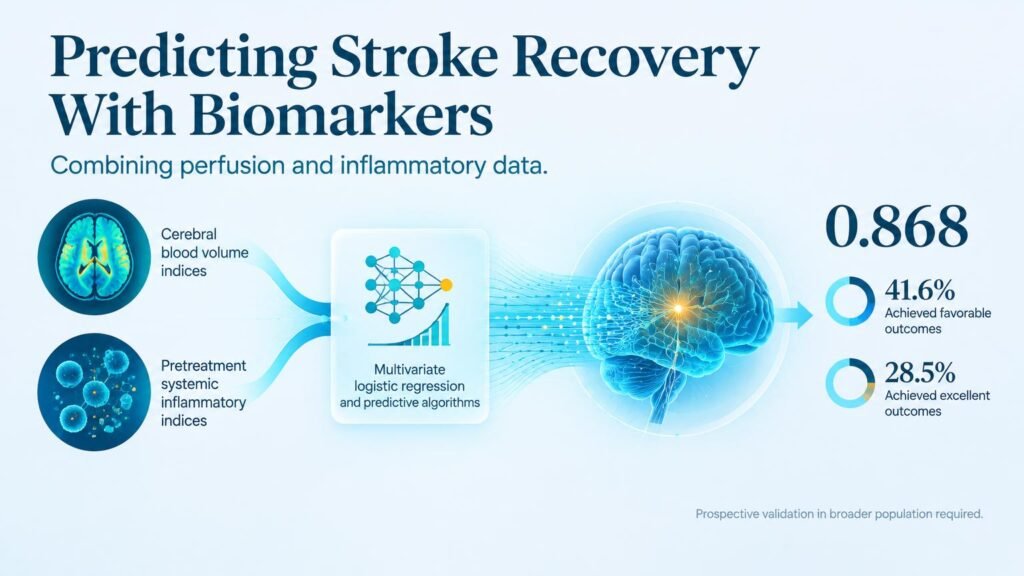
Restoring blood flow after a acute ischemic stroke does not guarantee a full recovery. Interventional radiologist opening an occluded vessel often leaves clinicians guessing which patients will regain independence. This study shows that neurovascular tissue status and peripheral inflammation must be evaluated together to understand true functional trajectory.
Combining local brain perfusion with systemic blood biomarkers challenges the standard practice of relying heavily on post-procedural imaging alone. Prior work has shown the CBV index predicts long-term prognosis after thrombectomy. But local blood volume tells only half the story if inflammatory cascades continue to destroy surrounding tissue.
Complementary signals improve prognostic accuracy
Researchers analyzed 474 patients treated with endovascular therapy (EVT) for anterior circulation large vessel occlusion between November 2020 and June 2024. Systemic inflammatory indices were derived from pre-treatment blood samples, while an independent cohort of 53 patients provided external validation. Overall, 41.6% of patients achieved a favorable outcome (mRS 0–2) and 28.5% achieved an excellent outcome (mRS 0–1).
Machine learning models demonstrated robust performance when combining the cerebral blood volume index with baseline systemic inflammation. Logistic regression achieved the highest AUC of 0.868 for predicting functional independence (mRS 0–2), while a Support Vector Machine (SVM) reached an AUC of 0.839 for excellent functional outcome (mRS 0–1). In external validation, performance remained strong with AUCs of 0.816 and 0.802, respectively.
Population attributable fraction analysis highlighted the distinct contributions of brain microvascular integrity versus body-wide immune response.
Improving microvascular tissue perfusion (higher CBV index) was estimated to increase favorable outcomes by 97.2% and excellent outcomes by 74.8%. Meanwhile, controlling inflammatory overactivation offered potential gains of 22.4% to 39.7% for favorable outcomes and 51.2% to 59.5% for excellent recovery.
What clinicians should consider
These risk scores predict functional trajectories, but they do not prove that altering blood biomarkers directly improves recovery. The primary limitation stems from the retrospective development cohort and a small external validation group of just 53 patients. Additionally, these correlations do not replace clinical judgment or guarantee individual recovery.
Before adopting predictive models in clinical workflows, health systems must validate them in prospective, diverse patient populations. Early risk stratification can help care teams identify high-risk patients who need aggressive anti-inflammatory management or intensive post-stroke rehabilitation.
Read the complete study in La radiologia medica.