Unsupervised machine learning reveals that tumor shape, not just invasion depth, dictates whether early colorectal cancer will return after endoscopic removal.
How deep is too deep? For years, oncologists have relied on a strict depth threshold to decide if a patient needs major surgery after early colorectal cancer removal. But a rigid millimeter cutoff misses the physical shape of the tumor, leaving some patients overtreated and others at risk.
Rethinking the depth metric
This study challenges the status quo. By using unsupervised machine learning to cluster patient data, researchers have shown that tumor shape must guide depth measurements. This shifts the clinical focus from a single metric to a multi-dimensional risk profile.
This matters because treating T1 colorectal cancer with endoscopic resection alone is highly desirable, but recurrence is devastating. If clinicians can use tumor shape—flat versus polypoid—to guide decisions for borderline invasion depths, they can avoid unnecessary, life-altering bowel resections. This builds on previous efforts to map recurrence, such as a 2013 study on factors associated with risk for colorectal cancer recurrence.
This finding directly addresses a long-standing clinical headache. When a pathologist sees submucosal invasion, the immediate reaction is often to recommend radical surgery. This aligns with earlier findings on the risk for incomplete resection, which highlighted how macroscopic features influence local control. The new clustering data takes this further by proving that morphology dictates long-term systemic recurrence, not just local clearance.
The three risk subtypes
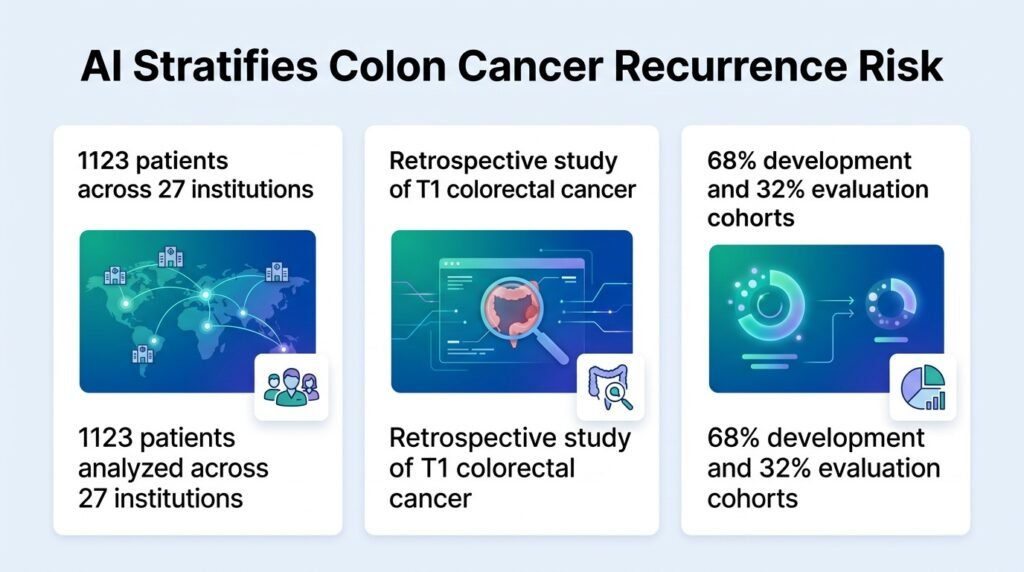
The retrospective study analyzed 1,123 patients with T1 colorectal cancer treated with endoscopic resection alone across 27 Japanese institutions between July 2009 and December 2016. Researchers split the patients into a development cohort of 68% and an evaluation cohort of 32%. Using K-means clustering, the algorithm identified three distinct risk subtypes.
- Subtype 1: Recurrence rate of 5.4% in the development cohort and 4.8% in the evaluation cohort.
- Subtype 2: Recurrence rate of 0.9% in development and 1.6% in evaluation, characterized by flat morphology.
- Subtype 3: Recurrence rate of 1.4% in development and 1.1% in evaluation, characterized by polypoid morphology.
A new decision tree
The resulting decision tree model mapped a clear hierarchy. Submucosal invasion under 1,000μm indicates low risk. However, invasion of 1,000μm or more requires morphological assessment. Polypoid lesions are classified as high risk, while flat lesions are further stratified using a 2,000μm threshold.
We must remain honest about the limitations. The data is retrospective and comes entirely from Japanese institutions, meaning the findings need validation in Western cohorts. Furthermore, the decision tree remains an exploratory framework that requires prospective clinical trials before it can safely replace current surgical guidelines.
The original study was published in Endoscopy.