A hybrid AI system reduces missed cancer risks by correcting flawed colonoscopy follow-up schedules.
Doctors frequently miscalculate when patients should return for repeat colonoscopies. Booking a high-risk patient too late increases cancer risk, while calling back a low-risk patient too early wastes overburdened endo-scopy capacity.
That error rate is not a clinical knowledge gap. It is an administrative failure caused by unreadable, unstructured free-text reports across separate hospital systems.
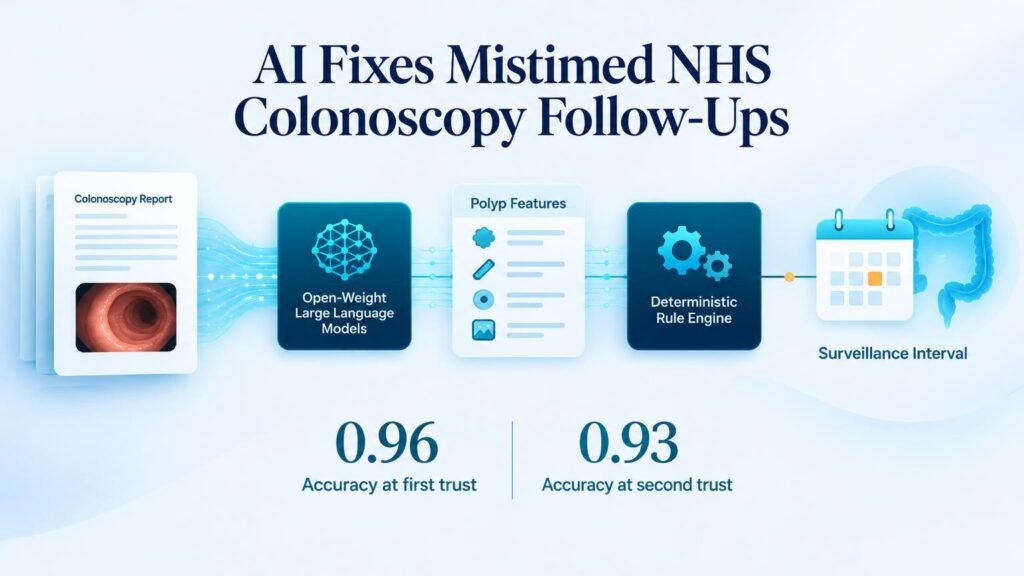
To fix this, researchers built a four-stage pipeline using open-weight large language models to extract polyp features from paired colonoscopy and pathology reports. Instead of letting an unpredictable language model calculate medical risk, the pipeline converts unstructured text into a structured schema and hands it off to a rule-based engine that enforces official guidelines.
How the tool performed
The system was evaluated across two National Health Service trusts using real patient records. It parsed free-text data, split multi-specimen reports into individual containers, and calculated surveillance intervals against a clinician-derived reference standard.
- Specimen type extraction reached 0.995 accuracy, while location and diagnosis accuracy both reached 0.981 across 100 procedures and 215 specimen containers.
- Excision completeness extraction achieved 0.949 accuracy, with a mean report comprehensiveness score of 0.968.
- Recommendation accuracy hit 0.96 at Guy’s and St Thomas’ NHS Foundation Trust and 0.93 during external validation at Sandwell and West Birmingham NHS Trust.
- Critical safety triggers reached a perfect 1.00 F1-score for cancer alerts at both hospital sites.
- The no follow-up category scored an F1-score of 0.98 internally and 0.97 externally.
What this changes
A retrospective audit of 127 patients showed that the automated pipeline outperformed routine clinical scheduling. The primary gain was not speed, but a clear reduction in undersurveillance, catching patients who would have otherwise been brought back too late.
This design choice offers a blueprint for clinical software. By separating messy text processing from strict medical decision logic, the software remains lightweight, deterministic, and fully auditable.
That distinction matters for regulatory approval and clinical trust.
Where it falls short
The system is not flawless. Performance dropped on intermediate decisions, with the F1-score for 3-year follow-up recommendations falling to 0.80 at the external validation site.
Retrospective validation on 200 total recommendation cases proves extraction accuracy, but it does not prove clinical adoption. Hospital deployments frequently stall when automated tools generate notification fatigue or fail to interface smoothly with legacy electronic health record systems.
Until prospective trials prove doctors act on these automated recommendations without adding review time, this system serves as an automated safety net rather than a replacement for clinical sign-off.
Read the full study in the Journal of Medical Internet Research.