
A highly anticipated multimodal AI outperformed other biomarkers at staging pancreatic cancer risk, yet it failed its primary test of matching the right drug to the right patient.
Why do we still treat metastatic pancreatic cancer with trial-and-error chemotherapy? For years, oncology has hoped that combining clinical data, genomics, and imaging into machine learning would end this guessing game. The PASS-01 trial challenge put this hope to a rigorous test. It pitted a multimodal AI called MULTIPL against standard biomarkers to see if algorithms can actually guide treatment selection between two brutal chemotherapy regimens.
The results are a sobering reality check for the multi-omics movement. While MULTIPL proved to be an excellent prognostic tool—meaning it can tell how sick a patient is—it failed to predict which specific drug would work better for individual patients. This distinction matters. A tool that merely predicts survival does not solve the clinical dilemma of drug selection.
This challenge aligns with broader efforts to build predictive models in oncology, such as integrating imaging and genetics for locally advanced pancreatic cancer, but highlights how hard it is to move from prognosis to true prediction.
The trial by numbers
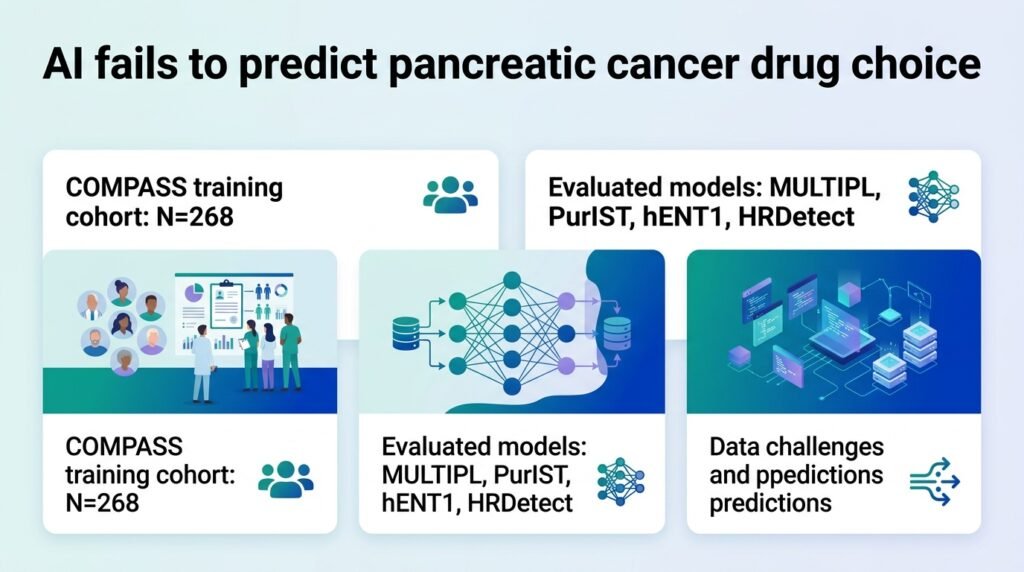
Researchers trained MULTIPL on the COMPASS study of 268 patients, integrating clinical data, digitized histopathology, whole-genome sequencing, and RNA-seq. They then validated the AI and other biomarkers like PurIST, hENT1, and HRDetect in the PASS-01 trial, a randomized phase II study of 160 patients comparing modified FOLFIRINOX (FFX) against gemcitabine plus nab-paclitaxel (GNP).
- MULTIPL achieved the highest concordance index for overall survival at 0.595 (95% CI, 0.55-0.65).
- It successfully separated high-risk and low-risk patients with a hazard ratio of 1.62 (95% CI, 1.13-2.33; P=0.009).
- Patients recommended for GNP by the AI lived significantly longer on GNP than on FFX, showing a hazard ratio of 0.47 (95% CI, 0.28-0.82; P=0.007).
- Conversely, patients recommended for FFX saw no difference in survival between the two treatments.
The predictive blind spot
Despite these strong prognostic numbers, MULTIPL and its competitors failed the primary endpoint. None of the biomarkers significantly predicted differential treatment benefit for progression-free survival.
This failure exposes a fundamental gap in current AI design. Algorithms excel at pattern matching to estimate risk, but they struggle to model how a dynamic tumor will react to a specific chemical assault. This highlights the limitations of static data and underscores why some researchers are shifting toward dynamic cancer digital twins to simulate treatment responses in real-time.
The trial did validate KDM6A alterations and SSTR1 expression as prognostic biomarkers. But until AI can reliably predict drug-specific benefits, clinicians are still left making high-stakes decisions in the dark.
Read the full study in medRxiv.