Standard medical billing codes are failing to track patient crises, leaving healthcare systems blind to critical mental health risks.
How can healthcare systems prevent suicide when their data misses three-quarters of the warning signs?
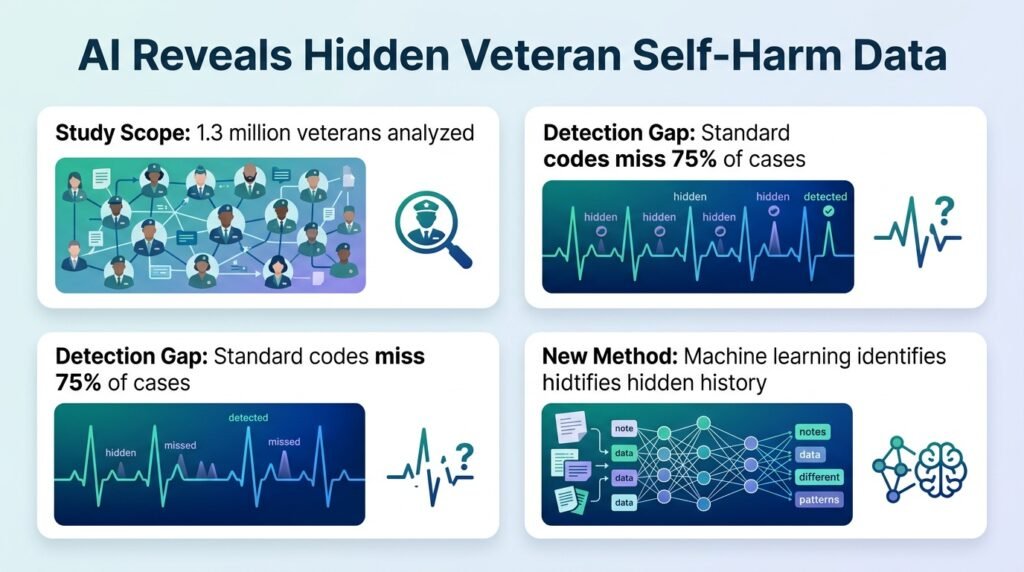
A massive analysis of 1.3 million veterans reveals a systemic failure in medical data tracking. Standard diagnostic codes captured only 1.85% of patients with a history of self-harm.
But when machine learning scanned the unstructured clinical notes, the true rate jumped to over 10%.
This is not a minor discrepancy. It is a massive blindspot that undermines predictive suicide-prevention models.
The Billing Code Blindspot
Predictive models are only as good as their inputs. Currently, hospital IT systems rely heavily on structured billing codes to flag high-risk patients.
This study proves that relying on these codes is dangerous. Doctors write the real story in free-text clinical notes, which standard algorithms ignore.
By leaving this data buried, health systems are building suicide-prevention models on incomplete foundations.
This is part of a broader trend where advanced algorithms are needed to clean up messy, real-world medical data.
The Implementation Bottleneck
Deploying these tools at scale is not a simple software update.
If hospitals deploy algorithms to flag every hidden risk, they risk overwhelming clinicians. Alert fatigue is already a major driver of physician burnout.
Adding more automated warnings without restructuring clinical workflows could cause doctors to ignore the alerts entirely.
The technology to find these hidden crises exists. The real hurdle is designing a system where clinicians can actually act on the data without drowning in noise.