
Wearable sensors analyzed by AI can spot sleep apnea, but shifting accuracy rates mean they cannot yet replace clinical sleep labs.
Clinicians hoping to clear massive diagnostic backlogs by prescribing wearable light sensors must wait. A new meta-analysis reveals that while artificial intelligence can analyze photoplethysmography (PPG) data to detect obstructive sleep apnea, its accuracy fluctuates based on disease severity. This instability means consumer wearables cannot yet bypass the gold-standard sleep lab.
The findings challenge the assumption that simple pulse oximetry and smartwatches can easily scale up sleep medicine. Instead of a uniform diagnostic tool, we have a system that behaves differently at every level of disease. This complicates clinical workflows, as a negative result on a wearable might miss the very patients who need urgent intervention.
The diagnostic trade-off
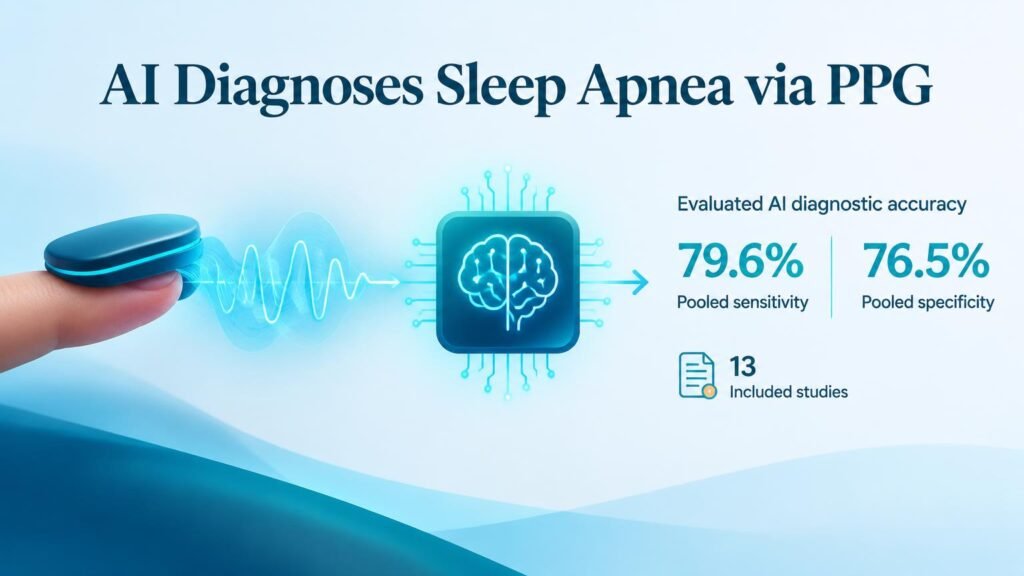
Researchers analyzed data from 13 studies involving 9,983 participants to assess how well AI interprets PPG signals. The overall performance was modest, yielding a pooled sensitivity of 79.6% (95% credible interval [CrI] 55.5%-93.8%) and a specificity of 76.5% (95% CrI 48.2%-94.0%). However, the real story lies in how these numbers shift when the severity of the apnea-hypopnea index (AHI) changes.
The analysis revealed a stark trade-off as disease severity increased:
- At mild severity (AHI ≥5), sensitivity reached 87.2% but specificity fell to 63.6%.
- At moderate severity (AHI ≥15), sensitivity dropped to 79.7% while specificity rose to 81.8%.
- At severe levels (AHI ≥30), sensitivity fell further to 76.7% while specificity climbed to 85.1%.
- Deep learning models achieved a higher specificity of 82.9% compared to 63.6% for traditional machine learning.
This pattern of shifting accuracy is a known hurdle in digital health. A recent scoping review in European Archives of Oto-Rhino-Laryngology highlighted similar inconsistencies across various AI models. While a validation study in Journal of Clinical Sleep Medicine showed promise for single-channel home tests, clinical readiness remains a bottleneck.
Limitations and next steps
The study’s limitations change how we must interpret these results. The underlying data suffered from small sample sizes, geographical underrepresentation, and potential confounding variables like patient movement during sleep. Because of these gaps, these algorithms are not ready to replace polysomnography.
For now, PPG-based AI should remain a preliminary screening aid rather than a diagnostic shortcut. Clinicians must treat normal readings in highly symptomatic patients with skepticism, as the AI’s sensitivity drops precisely when the patient’s condition is most severe.