
A triple-masked trial shows that AI-assisted exercise plans perform just as well as human-designed physical therapy for shoulder pain.
If an algorithm can write your physical therapy plan, what are you paying the human expert for? For years, the medical establishment argued that clinical intuition could not be automated. This new trial complicates that defense.
By showing that clinician-curated AI plans yield identical functional recovery to bespoke human designs, the study suggests that the “art” of exercise prescription might actually be a highly structured science. This shifts the role of the therapist from a creative designer to a critical editor.
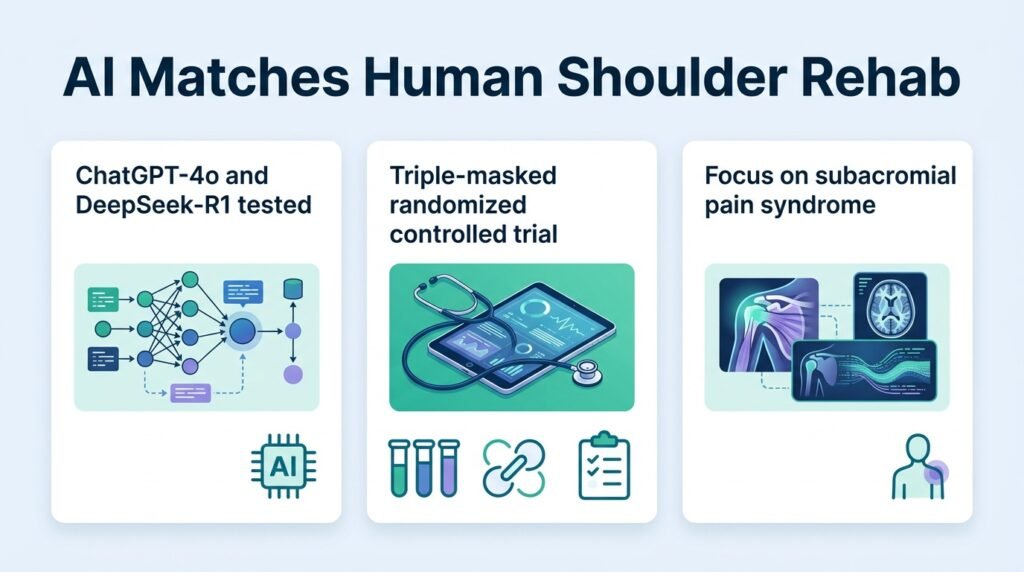
The trial evaluated **75** adults aged **18 to 65** with subacromial pain syndrome, with **69** completing the 6-week protocol. Researchers split them into three groups: conventional human-designed therapy, clinician-curated ChatGPT-4o plans, or clinician-curated DeepSeek-R1 plans. All participants received identical physical therapy modalities and supervised exercise sessions **3** times per week for **6** weeks.
How the models compared
The results challenge the assumption that human-only design is superior:
- The primary outcome, the Shoulder Pain and Disability Index, improved across all groups with no significant difference (P = 0.428).
- Secondary outcomes like activity pain (P = 0.744) and arm/hand disability (P = 0.744) showed no statistical difference between groups.
- Physical health summary scores also remained statistically tied (P = 0.374).
- DeepSeek-R1 showed a surprise advantage in resting pain over conventional programming, with a mean difference of 2.74 (95% CI, 1.26 to 4.22; P = 0.005).
No adverse events were reported in any group.
The editor-in-chief model
The observed resting-pain difference in favor of DeepSeek-R1 was exploratory and requires replication. It would be a mistake to declare the AI superior based on this single metric. However, the study proves the viability of the “clinician-curated” model.
The AI did not work in a vacuum. Humans still vetted the outputs. This hybrid workflow aligns with the evolving framework for integrating artificial intelligence into physical therapy, where algorithms handle the baseline logic and humans manage safety.
If AI can reliably draft the routine, the therapist’s value proposition shifts entirely. It moves away from drafting exercises to real-time form correction, motivation, and hands-on adjustments.
Read the full study in Scientific Reports.