 Yusuf Yesil, MD, MIS
Essential tremor and dystonic tremor look nearly identical in routine clinic visits. Because each condition requires a different treatment, misdiagnosis directly harms patient care. Clinical teams have looked to machine learning on wearable motion sensors to objectively tell the two apart.
A new multi-center study shows why algorithmic answers remain unreliable. When algorithms learn on patient data from a single hospital, they pick up local diagnostic biases instead of universal biological signals.
Local Success, Global Failure
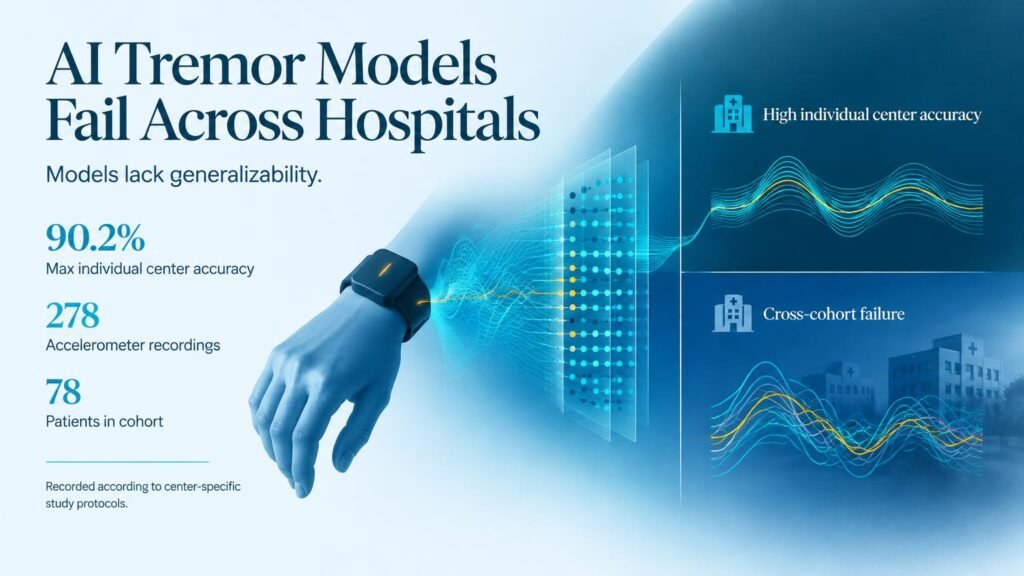
Researchers evaluated 278 accelerometer recordings gathered from a multi-center cohort of 78 patients, including 37 with essential tremor, 27 with dystonic tremor, and 14 with tremor associated with dystonia. The team extracted more than 7,000 features from tri-axial postural movement signals recorded under center-specific protocols.
Within single academic centers, supervised models performed exceptionally well. Yet those findings completely fell apart across different sites.
- Single-center models reached peak diagnostic accuracy of 90.2%.
- Zero features generalized across cohorts when applied to external datasets.
- Unsupervised machine learning uncovered two distinct signal clusters that did not match traditional clinical labels.
That collapse is the real warning.
High accuracy inside a single center did not reflect true disease signatures. Instead, the models overfit to center-specific recording protocols and local clinician diagnostic styles. This mirrors wider concerns about whether smartphones and machine learning are enough to diagnose tremor without strict protocol standardization.
Inconsistent Expert Diagnoses
The failure of these models exposes a deeper clinical problem. Even expert movement disorder centers diagnose tremor syndromes inconsistently. When the clinical gold standard varies by site, algorithms trained on those labels inherit human inclusion bias.
Distinguishing these movement disorders has long challenged neurologists, as detailed in research on the pathophysiology of dystonic tremors and comparison with essential tremor. If human experts cannot agree on exact boundary lines, supervised models trained on their notes will inevitably fail outside local walls.
Data-driven tools cannot simply replace existing diagnostic criteria today. Instead, researchers must use unsupervised algorithms to find truly objective, generalizable movement patterns before training clinical tools.
What Needs to Change
For health systems, this study provides a clear mandate. Single-site retrospective accuracy rates above 90% should never be taken as proof of clinical readiness.
Until academic centers harmonize how they record tremor data and define patient cohorts, wearable AI tools will remain site-bound research prototypes rather than objective clinical instruments.
Read the full paper in Frontiers in Neurology.