
Clinicians can screen latent tuberculosis using epidemiological data instead of expensive blood work, but algorithmic risk scores cannot yet replace definitive diagnostic tests.
Public health programs routinely struggle to identify which patients with latent tuberculosis infection (LTBI) will progress to active disease. Standard lab tests are expensive and out of reach for resource-limited clinics, leading to either overtreatment or missed active cases.
That bottleneck leaves millions without timely intervention.
A new multicenter study challenges the assumption that accurate risk stratification requires costly biological markers. Researchers built an interpretable algorithm using only simple questionnaire data to separate active pulmonary tuberculosis (PTB) from latent infection.
Epidemiological Data Replaces Blood Work
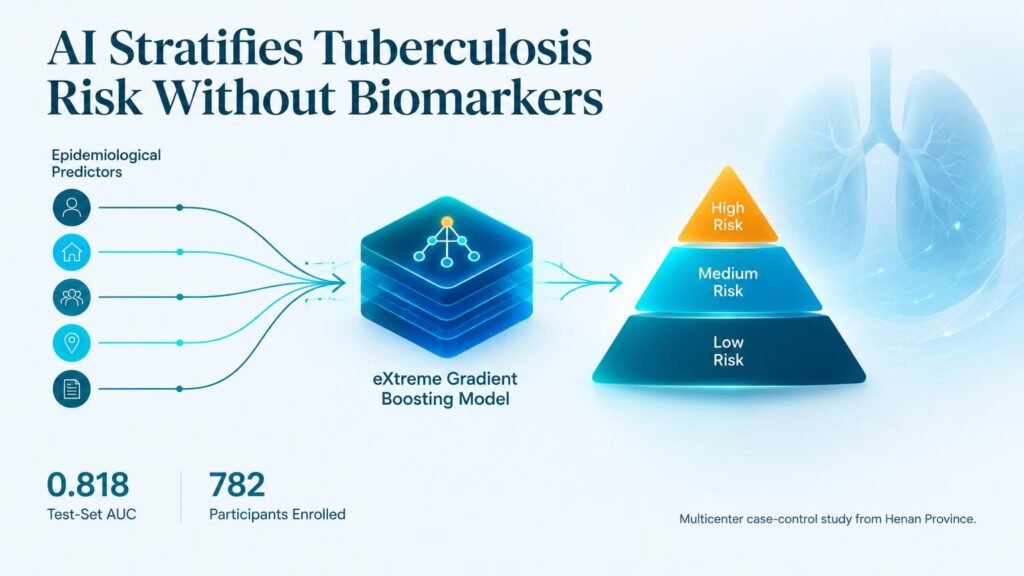
The study enrolled 782 participants across 21 designated tuberculosis institutions in Henan Province, China, comprising 401 individuals with LTBI and 381 newly diagnosed, treatment-naive PTB patients. Researchers collected epidemiological predictors through face-to-face surveys and split the data into a 7:3 training and testing ratio. Eleven predictors were selected using ten-fold cross-validated LASSO regression to train seven machine learning models.
The eXtreme Gradient Boosting (XGB) model outperformed competing algorithms on the test set. It achieved an AUC of 0.818, an F1 score of 0.764, and a Brier score of 0.176 with favorable calibration. Decision curve analysis confirmed a consistent positive net benefit across clinical thresholds.
Feature analysis via SHapley Additive exPlanations (SHAP) showed that risk was driven primarily by male sex, low body mass index, advanced age, unintentional weight loss within six months, and low annual household income. Similar work, such as a study on predicting LTBI risk in close contacts, reinforces the predictive power of non-invasive social and clinical indicators in low-resource settings.
Triage Results
- Low-Risk Tier (< 0.328 cutoff): Contained a 20.00% proportion of PTB cases.
- High-Risk Tier (> 0.763 cutoff): Concentrated a 84.29% proportion of PTB cases.
- Deployment: The final model was hosted as a free web calculator for clinical testing.
Operational Impact and Limitations
This approach offers a practical triage tool for primary healthcare workers who lack immediate access to advanced diagnostic infrastructure. By using cheap demographic and symptomatic inputs, clinic workflows can prioritize high-risk patients for secondary confirmatory testing without overwhelming lab capacity. Related research on risk factors for latent tuberculosis infection highlights how data-driven screening reduces operational overhead in regional centers.
However, retrospective case-control data from a single province is not proof that the software improves downstream patient outcomes. Because the tool relies on self-reported survey data, recall bias remains a challenge. The web calculator is strictly a research prototype that requires prospective evaluation and external validation before it can direct preventive treatment decisions in the clinic.
Source study published in BMC Public Health.