
Using AI models to simulate patient feedback on discharge notes risks masking genuine patient confusion, particularly for lower-literacy groups.
Hospitals are eager to run patient-facing text through AI personas to ensure instructions are clear before handover. But synthetic patients do not think like real human beings. They act like well-educated, highly confident readers who almost never get confused.
That overconfidence creates a clinical hazard.
When discharge summaries fail to land, patients miss medication doses and miss warning signs of post-operative complications. Relying on digital stand-ins to vet these materials risks letting flawed instructions pass directly to vulnerable patients.
Testing the AI personas
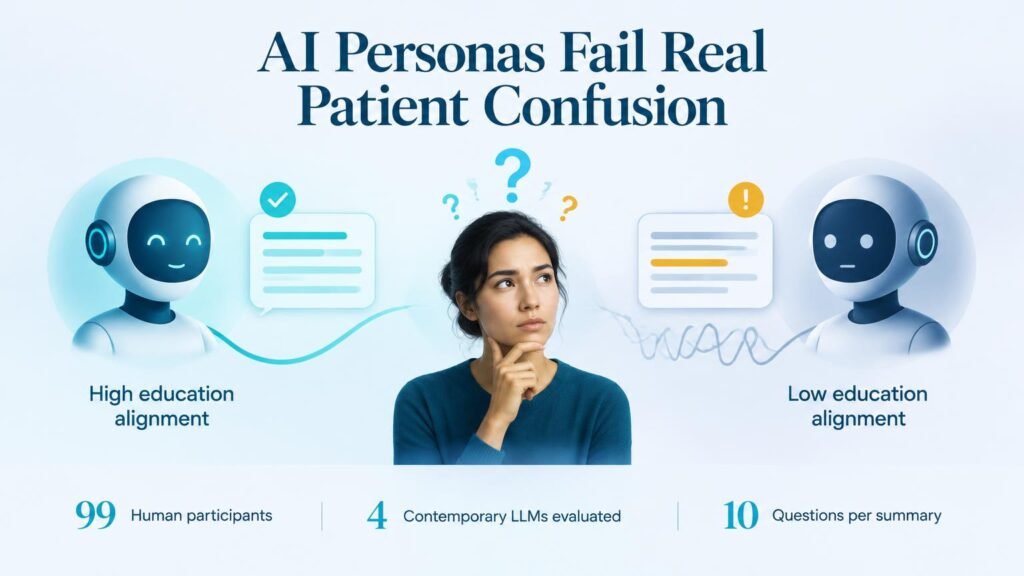
A trial evaluated 4 frontier models—GPT-4.1, GPT-5.2, Claude Sonnet 4.5, and Opus 4.6—to see if demographic persona prompting could match real human feedback. Researchers benchmarked synthetic responses against a general-population cohort of 99 human participants recruited via Prolific.
Participants and models answered 10 questions per discharge summary. The questions covered both factual comprehension items and subjective perception items across summaries that varied in length and medical complexity.
Every model tracked human responses far better on factual questions than on subjective perception. Education was the most consistent point of failure: all 4 models aligned well with high-education human responses, but struggled to accurately mirror low-education participants on basic comprehension items.
Overconfidence in complex notes
Subjective perception exposed the deepest rift between models and humans. Real patients routinely express uncertainty when digesting hospital paperwork, but the AI personas systematically dodged expressing doubt.
Across all model architectures, the LLMs heavily underselected “I don’t know” and “Not provided” options compared to real participants. The models insisted on committing to clear-cut answers even when the underlying clinical text was vague or incomplete.
This divergence peaked on discharge summaries that were short but clinically complex. Where real human readers felt lost, the synthetic personas hallucinated understanding. Running a chain-of-thought sensitivity analysis improved performance on select factual items, but it still failed to reproduce the wide spectrum of human responses.
Key performance gaps
- Stronger model alignment on factual recall than on subjective patient perception across all benchmarked LLMs.
- Consistent failure to accurately model low-education subgroups compared to high-education cohorts.
- Systematic underselection of “I don’t know” and “Not provided” options, masking real-world human hesitation.
- Maximum divergence between models and humans occurred on brief, clinically dense discharge notes.
What health systems must change
Persona prompting cannot serve as a direct replacement for human validation. While these models offer a rapid initial screening tool for formatting and obvious errors, they systematically hide human confusion.
Health systems that deploy these tools must maintain human review panels with diverse educational backgrounds. Relying solely on synthetic personas ensures that the patients who need clear instructions the most will continue to receive notes they do not understand.
Read the full study in the Journal of Medical Internet Research.