
An FDA-authorized AI tool for lung disease is directly altering how doctors treat patients and avoiding invasive procedures.
Changing Real-World Care
Getting a timely diagnosis for interstitial lung disease is notoriously difficult, often requiring months of testing and risky surgical biopsies. Recent research in artificial intelligence and machine learning in respiratory medicine highlights the push to shift diagnostic decisions earlier. A new prospective study shows that deployment of an FDA-cleared imaging algorithm is finally changing clinical choices at the point of care.
That shift matters far more than theoretical accuracy.
Instead of staying trapped in offline validation models, the software altered physician decision-making across community and academic hospitals alike. Clinicians moved faster to start guideline-based drugs while backing off invasive diagnostic procedures.
Tracking Key Patient Outcomes
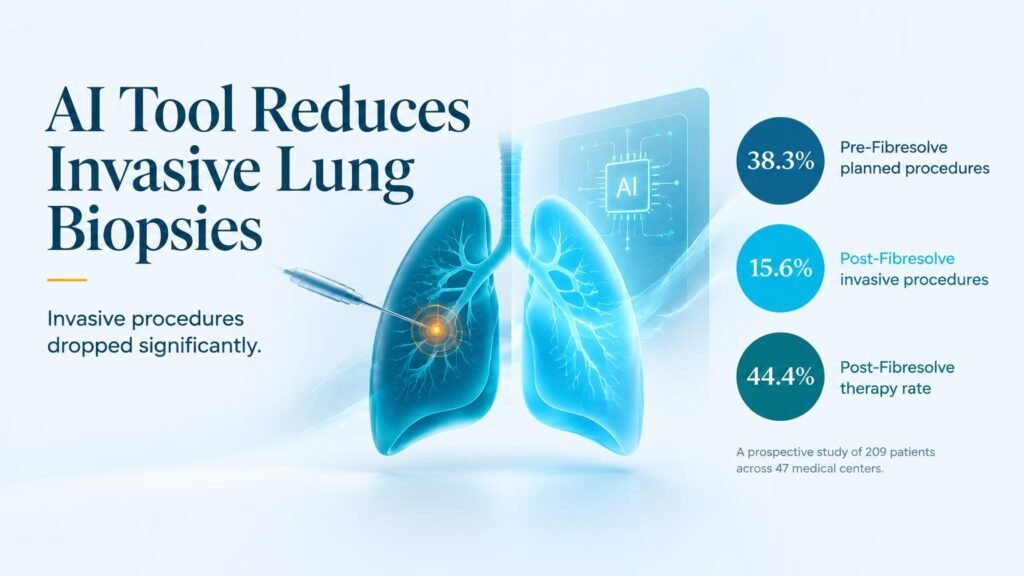
The study tracked patients across 47 US medical centers between July 2024 and June 2026. Out of 209 total patients, 152 were managed in 31 community practices, while 57 were evaluated at 16 academic sites. This distribution reflects actual clinical practice outside elite research centers.
- Fibresolve returned a positive result for idiopathic pulmonary fibrosis in 89 of 209 patients (42.6%).
- Targeted pharmacotherapy rates jumped from 12.5% to 44.4% after using the tool.
- Planned invasive diagnostic procedures dropped from 38.3% (59 of 154 patients) down to an actual performance rate of 15.6% (12 of 77 patients).
Behavior Versus Diagnostic Truth
These figures demonstrate a clear change in practice, but they also highlight a critical analytical distinction. The trial measured clinical utility and physician behavior rather than algorithmic accuracy against tissue biopsy ground truth. Similar questions exist across broader research on the diagnosis of early idiopathic pulmonary fibrosis, where clinical adoption frequently moves faster than tissue confirmation.
When AI convinces a doctor to cancel a surgical biopsy, it reduces immediate patient risk and cuts care costs. Yet if the algorithm yields a false positive, a patient might start long-term medication without having the underlying disease. Observational data proves that doctors trust the tool, but it cannot confirm whether every treatment change was clinically correct.
Health systems evaluating this software should treat it as a workflow catalyst rather than a diagnostic replacement. The practical takeaway for medical leaders is simple. Systems must track long-term patient outcomes alongside procedure cutbacks to ensure clinical safety keeps pace with rapid adoption.
Read the full study in Diagnostics.