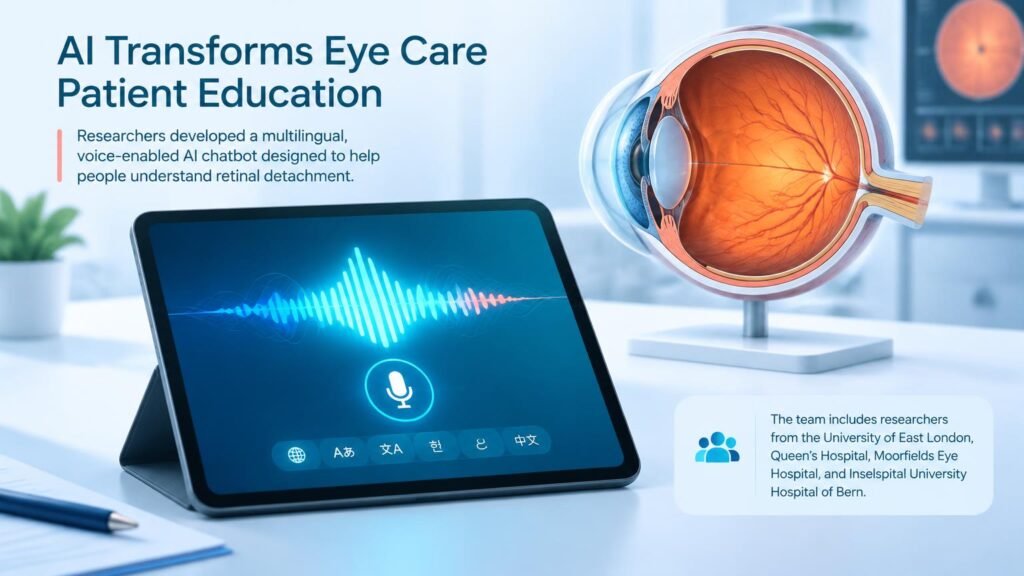
Interactive voice assistants built with clinical guardrails are targeting the communication gap in post-surgical eye care.
Paper medical leaflets fail patients with failing eyesight. Expecting someone recovering from retinal detachment surgery to read fine print on a printed discharge sheet creates immediate risks during post-operative recovery.
Interactive voice assistants offer a direct alternative. By combining speech capability with Retrieval-Augmented Generation, a specialized AI system can answer complex post-surgical queries across dozens of languages.
Guardrails over generation
The critical hurdle for patient-facing AI remains medical accuracy. To prevent hallucinations, researchers grounded the system in a clinician-curated knowledge base derived strictly from peer-reviewed literature.
Among evaluated architectures, GPT-4o achieved the highest clinical accuracy in benchmark testing. The voice interface directly addresses accessibility barriers for visually impaired patients and non-native speakers who struggle with standard written materials.
The validation gap
Better communication does not automatically yield better clinical outcomes.
While benchmark accuracy demonstrates technical feasibility, current data reflects controlled testing rather than live clinical trials. Static accuracy metrics cannot predict patient adherence or measure whether voice tools actually reduce emergency clinic callbacks.
Healthcare providers should view voice-enabled tools as accessibility supplements rather than labor-saving replacements for clinical staff. The immediate value lies in bridging language and vision barriers at discharge, but real-world efficacy requires prospective clinical validation before broad deployment.