
Visual AI alerts do not make dentists more accurate, and they can actually coax less-experienced clinicians into agreeing with incorrect software predictions.
Adding AI to dental imaging workflows is supposed to catch missed pathology. Yet a new randomized trial reveals that visual overlays and text recommendations did not improve diagnostic accuracy for bone loss. In fact, the software introduced a subtle form of cognitive bias that degraded clinical performance.
This challenges the industry assumption that more visual guidance automatically yields better clinical decisions. It shows that UI design is not just an aesthetic choice; it is a clinical variable. If visual cues lead students to trust bad advice, we are designing tools that scale human error rather than eliminate it.
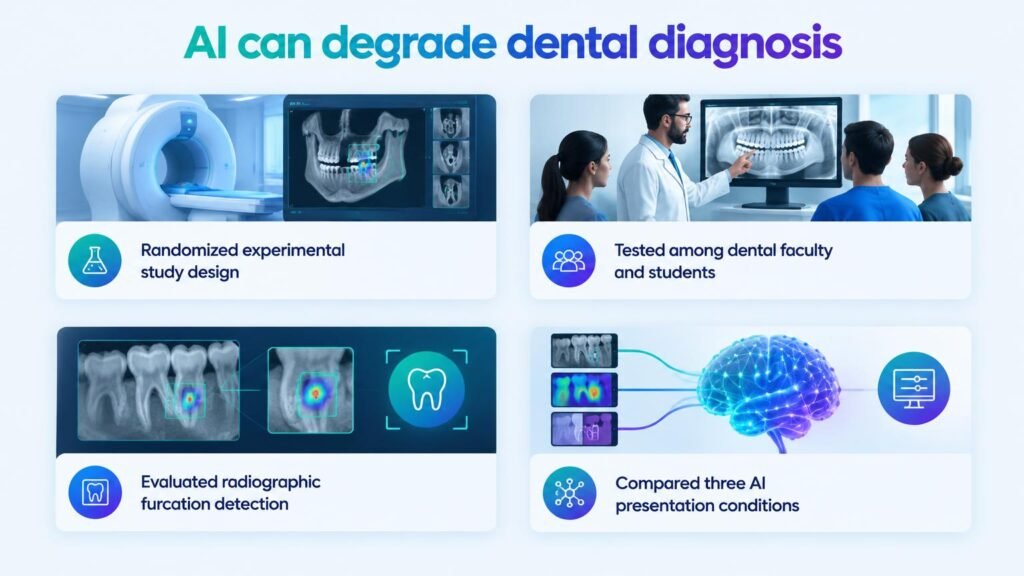
Researchers evaluated **122** participants, including **60** dental faculty members and **62** predoctoral students, diagnosing radiographic furcation defects. The cohort was split into three groups: **41** received no AI assistance, **40** saw visual AI annotations, and **41** read descriptive text-based AI recommendations. This study builds on growing interest in dental AI, such as deep-learning models used for caries detection and segmentation. However, while raw model performance is heavily studied, the human-AI interface remains a critical bottleneck.
The diagnostic data
The primary metrics show a surprising trend where AI assistance slightly lowered overall accuracy, though the difference was not statistically significant.
- Overall diagnostic accuracy was **87.8%** for the control group, compared to **84.0%** for the visual AI group and **84.4%** for the descriptive AI group.
- Students using visual AI annotations showed significantly greater agreement with **incorrect** AI recommendations on specific difficult cases, like tooth #18.
- Faculty members who received visual AI outputs reported **reduced post-task confidence** compared to students, despite their clinical experience.
The confidence gap
The contrast between faculty and students is telling. Experienced faculty lost confidence when confronted with visual AI overlays, perhaps because the software conflicted with their clinical intuition. Students, on the other hand, blindly followed the visual prompts. This suggests that AI tools can act as a crutch for novices, cementing incorrect habits early in their training.
This risk is amplified by external factors like image quality, which already complicates digital diagnostics as explored in studies on image resolution’s impact on human accuracy. We must acknowledge the study’s limits. This was an experimental, case-based simulation rather than a live clinical trial, meaning it does not capture real-world patient outcomes or long-term workflows.
The practical takeaway is clear. Dental clinics should not deploy AI diagnostic tools without training clinicians to question the software. Until UI designs actively encourage critical thinking rather than passive agreement, AI integration risks doing more harm than good to diagnostic precision.
Read the full study in BMC Medical Informatics and Decision Making.