
Fetal monitoring algorithms usually cheat by knowing when birth happens, but a new model finally tracks risk in real time.
Doctors cannot predict the exact minute a baby will be born. Yet, almost every AI model designed to spot fetal distress during labor assumes they can. These algorithms rely on a clean, 30-to-60-minute window of heart rate data right before delivery. That is a luxury real-world obstetricians never have.
This methodological shortcut makes most academic fetal-monitoring AI useless in a delivery room. If a model needs to know the end of a timeline to make a prediction, it cannot help during the actual event. By reframing the problem as a time-to-event survival task, researchers are finally forcing machine learning to operate under clinical reality.
A realistic clinical lens
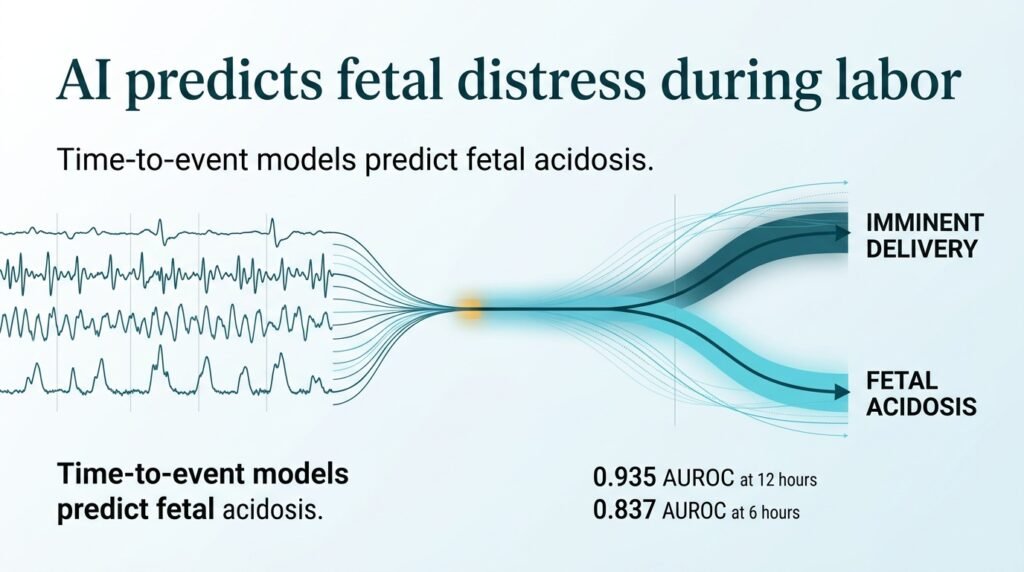
The new model, called Marked DeepHit, treats labor as a continuous, unfolding timeline. It analyzes continuous cardiotocography signals to predict the joint probability of imminent delivery and fetal acidosis. Acidosis is a dangerous biomarker of oxygen deprivation measured from umbilical cord gas immediately after birth.
Instead of looking backward from delivery, this system evaluates physiological signals at specific landmarks during active labor. This allows the algorithm to update its risk assessments dynamically as the hours tick by.
How the model performed
The researchers validated their approach using data from two different clinical sites. The model proved highly accurate at predicting delivery within one hour at multiple intervals.
- At 6 hours into labor, the model achieved a test-set AUROC of 0.837 with a confidence interval of 0.692 to 0.970.
- By 12 hours into labor, prediction accuracy rose to an AUROC of 0.935 with a confidence interval of 0.858 to 0.964.
- The system outperformed other clinical feature-based proposals on both internal and external validation.
Crucially, the model matched the performance of older algorithms that had the unfair advantage of knowing the delivery time in advance.
Why this shift matters
This finding challenges how the medical AI field evaluates predictive tools. For years, researchers have published high accuracy rates using retrospective datasets that are structured differently from real clinical workflows. This study proves that we do not need to cheat to get highly accurate predictions.
A dynamic risk score allows clinicians to plan interventions before oxygen deprivation causes permanent injury. It shifts the technology from a retrospective auditing tool to an active bedside assistant.
However, the wide confidence interval at the 6-hour mark shows that early labor remains difficult to model. Performance can be highly variable before labor progresses. Prospective clinical trials are still required to prove these risk scores improve actual birth outcomes.
Read the full study on medRxiv.