
A major gap exists between how seizure-predicting algorithms perform in lab simulations and how they handle the chaotic reality of the human brain.
Why do neuro-tech algorithms look flawless on paper but fail in actual patients? The answer lies in neural drift. The human brain constantly rewires itself, meaning an AI trained on yesterday’s brainwaves is often useless tomorrow.
This reality check exposes a quiet crisis in medical AI. For years, researchers have published high accuracy rates using static, offline datasets. This study proves those numbers are largely an illusion, forcing us to rethink how we validate clinical brain-computer interfaces.
The Real-World Performance Drop
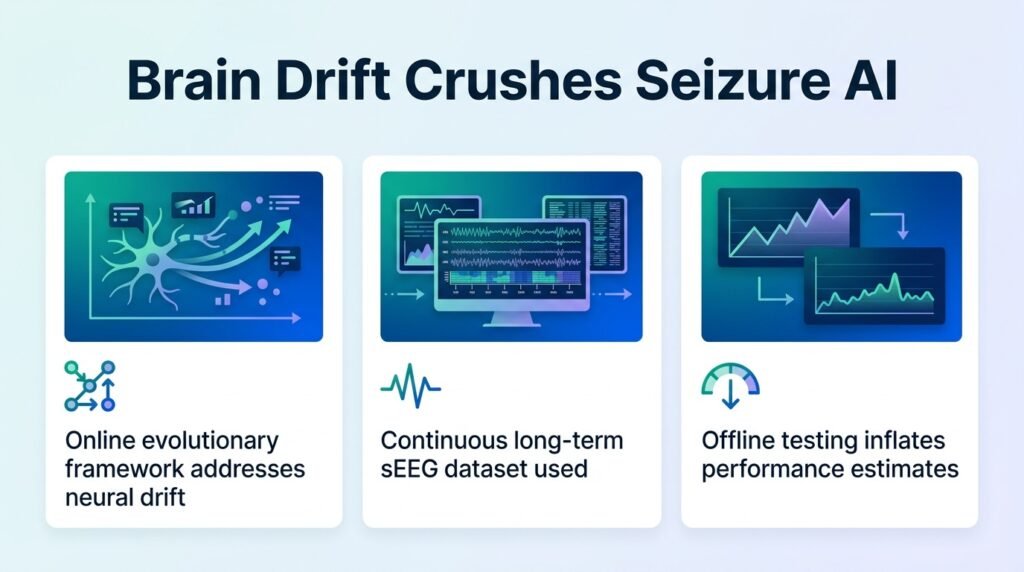
The researchers tracked 16 patients across 664.9 hours of continuous brain data, capturing 121 seizures. When tested on static, offline data, the best machine learning models achieved a stellar 90% mean accuracy score. But when the researchers ran those same models in a realistic, continuous online simulation, performance plummeted to just 57.9%.
That disconnect is the real story.
It confirms that neural drift quickly degrades static algorithms. If a clinical device cannot adapt to the brain’s shifting baselines, it cannot protect patients in the real world. Traditional validation methods are simply hiding this degradation by using artificial class rebalancing.
Evolving Models in Real Time
To counter this decline, the team developed an evolutionary framework that constantly adapts. Instead of relying on a single static model, they generated 1,000 candidate models per patient that evolved over continuous data streams. The pipeline selected monopolar referencing, cross-correlation-based connectivity matrices, and Random Forests classifiers as its core elements.
This adaptive approach achieved complete event-level seizure prediction in 75% of patients. It also successfully predicted all but one seizure in 87.5% of the cohort. Crucially, the system did not need to monitor the entire brain to get these results.
By targeting specific patient networks, the researchers reduced the required implanted contacts by 79.12%. This reduction actually provided superior predictive performance over clinically resected areas.
Why This Finding Matters
This finding changes the hardware requirements for brain-computer interfaces. Proving that we can monitor 79.12% fewer brain contacts makes surgical implants far less invasive and much safer. It shifts the industry focus from bulky, high-channel hardware to smarter, self-updating software.
If implants can adapt to neural drift on the fly, patients can finally get reliable, early warnings before a seizure strikes. It moves the field away from rigid, one-size-fits-all models toward continuous, personalized computation.
- Offline model accuracy fell from 90% to 57.9% when tested in real-time conditions.
- The evolutionary framework achieved perfect seizure prediction in 75% of patients.
- Targeting specific networks cut the required brain contacts by 79.12%.
Read the full study in medRxiv.